Theme: rule of law — full compilation
Legal and constitutional norms tested by the conduct of state power.
View as list →
What the Cold War Did to Passports
Sep 13, 2025 ·
BlueSky, Julia Rose Kraut
Historian Julia Rose Kraut, author of 'Threat of Dissent,' surfaced the Kent v. Dulles precedent on Bluesky in response to an Intercept report that Secretary of State Marco Rubio — who has already sought to punish immigrants for their speech — would have new legislative authority to extend that punishment to U.S. citizens; in 1958 the Supreme Court held that the right to travel cannot be conditioned on a citizen's political speech.
The Intercept reported in September 2025 that Secretary of State Marco Rubio, who as senator and as secretary had already sought to punish noncitizens for protected speech, was poised under newly proposed legislation to extend that authority to U.S. citizens — most concretely through revocation of passports as a sanction for political activity. Historian Julia Rose Kraut, whose book Threat of Dissent documents the federal record of speech-based passport and citizenship sanctions across the twentieth century, posted a brief reminder to the public conversation: it was tried in the Cold War; the Supreme Court intervened.
The Court’s 1958 ruling in Kent v. Dulles held that the right of a U.S. citizen to travel — including the State Department’s discretion in denying passports on the basis of political beliefs — could not be conditioned on speech without specific statutory authority that did not, in that case, exist. The legislation the Intercept describes would be the kind of authority the Court found absent. Kraut does not predict what the courts will do; she points at the historical fact that the question has been answered before.
Read original →
Fifty-Plus Cases That Fell Apart
Oct 18, 2025 ·
BlueSky, Nicole Foy
A ProPublica investigation methodically tracked over fifty cases of US citizens detained by immigration agents on charges that were either dismissed in court or never filed at all — including a woman accused of an assault that wasn't on video and a charge listing the injury as 'the thumb of an ATF Special Agent.'
A ProPublica investigation by reporter Nicole Foy tracked, by sourcing from social media, court records, and local press in Spanish and English, more than fifty cases of US citizens detained by federal immigration agents on charges that subsequently collapsed in court or were never filed at all. The pattern crossed demographics: senior citizens tackled, pregnant women handcuffed, children detained, a veteran pulled from his car on the way to work.
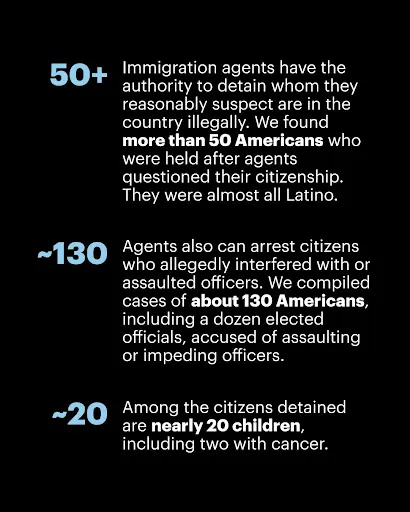
The mechanism for entry into custody was often not a citizenship-status question at all but an alleged assault on or interference with an officer. The catalogue includes the case of Andrea Velez, an LA woman accused of an assault that did not appear on the available video, whose case was dismissed by a federal judge. Other charges in the sample included causing an injury to “the thumb of an ATF Special Agent,” using a trash can to block CBP cars, and “resisting arrest” of unspecified scope.
The investigation’s methodology was, by the reporter’s own description, ad hoc — TikTok, Instagram, a personal spreadsheet — necessitated by the absence of any official agency tracking of US-citizen-in-custody incidents. The number 50+ is, on the same logic, a floor rather than a count.
Read original →
Tear Gas Almost Every Day
Oct 31, 2025 ·
Bellingcat
After U.S. District Judge Sara Ellis issued a temporary restraining order on October 9 limiting federal agents' use of crowd-control weapons against Illinois protesters, court filings allege that federal agents violated the order 'almost every day,' including a Halloween-eve incident in which children on their way to a school parade were tear-gassed.
On October 9, U.S. District Judge Sara Ellis issued a temporary restraining order against federal agents operating under Operation Midway Blitz in Illinois, restricting their use of tear gas, pepper spray, and other “riot control weapons” against protesters and journalists, and barring them from clearing people from public spaces those people had a lawful right to occupy. A subsequent court filing alleges that the order has been violated “almost every day” since it was issued. On October 25, federal agents reportedly deployed tear gas in Chicago’s Old Irving Park as children walked to a Halloween parade at their school. From the bench, on Tuesday, Judge Ellis said: “I can only imagine how terrified they were.”
When the judge asked Customs and Border Protection commander Gregory Bovino to produce all use-of-force reports from agents involved in Operation Midway Blitz since September 2, Bovino said it would be impossible because of “the sheer amount.” The court ordered the reports and accompanying body-camera footage produced by the end of the week. The volume of force itself — too large to assemble — is a piece of evidence that did not exist, in that quantifiable form, before the question was put.
Read original →
Held for the Likes
Nov 11, 2025 ·
Forever Wars, Spencer Ackerman
Yaa'kub Ira Vijandre, a Texas photojournalist and DACA recipient, has been held in ICE custody for his Instagram posts and likes expressing support for Palestine; new court filings frame him as a political prisoner.
Yaa’kub Ira Vijandre, a photojournalist from Arlington, Texas, and a DACA recipient, was taken into Immigration and Customs Enforcement custody at gunpoint, where he has remained. The basis of the federal case against him, on the documents, is his pattern of social-media activity: Instagram posts and the act of “liking” content expressing support for Palestine and for U.S. citizens whom Vijandre considered wrongfully convicted.

A new filing in Vijandre’s case asserts that he was offered the option of becoming an informant in exchange for his release and refused. The filing characterizes Vijandre as a political prisoner — held not for an act, but for the protected expression of an opinion the Department of Homeland Security disfavors.
Read original →
The Sheriff Who Spoke Up
Feb 3, 2026 ·
Bangor Daily News, Phil Lewis
A day after Cumberland County, Maine sheriff Kevin Joyce publicly criticized ICE for arresting one of his corrections officers, ICE served the county with a subpoena demanding employment data on every person who had worked at the jail since January 2025; the agency separately ended its long-standing detention contract with the county.
Kevin Joyce, the sheriff of Cumberland County, Maine, held a press conference during ICE’s January enforcement surge in the state to criticize the agency’s tactics. The day before, federal agents had arrested one of his own corrections officers — Emanuel Ludovic Mbuangi Landila, an Angolan immigrant whom Joyce described as “squeaky clean” and who had passed multiple background checks and held a valid work permit. The day after the press conference, ICE served the county with a subpoena demanding employment data on every person who had worked at the Cumberland County jail since January 2025. The county complied. ICE separately began moving detainees out of the jail, which had housed federal detainees under a long-standing contract; an agency spokesperson said it could no longer partner with a jail that employed an “illegal alien.”
Joyce had spoken publicly. The subpoena and the contract termination followed within hours and a day, respectively. The Bangor Daily News notes that the formal reason for the subpoena has not been articulated by the agency. The sequence — a federal agency, criticized by a local official, demands employment records on that official’s entire workforce — reads as either coincidence or signal; the article does not name it as one or the other, but Maine sheriffs are not numerous, and other Maine sheriffs may now have opinions about whether to hold press conferences.
Read original →
Five Patterns of Defiance
Feb 10, 2026 ·
Politico
Federal judges hearing immigration cases have begun to articulate a recurring playbook of administrative noncompliance with their orders — across detainee transfers, deadlines, release conditions, post-release treatment, and bond hearings.
Federal judges adjudicating immigration cases under the second Trump administration have begun publicly cataloguing a pattern of noncompliance with their orders. The list, as enumerated by judges in Minnesota and elsewhere, runs to at least five recurring tactics: detainees rapidly relocated across state lines (often to Texas or New Mexico) before habeas challenges can ripen; court deadlines for response simply ignored, with growing frequency; bail-style “conditions” like GPS monitoring imposed on people the judge has already ordered released; release into the cold or far from home, without identification, wallets, or warm clothes; and bond hearings that fall measurably short of constitutional standards.
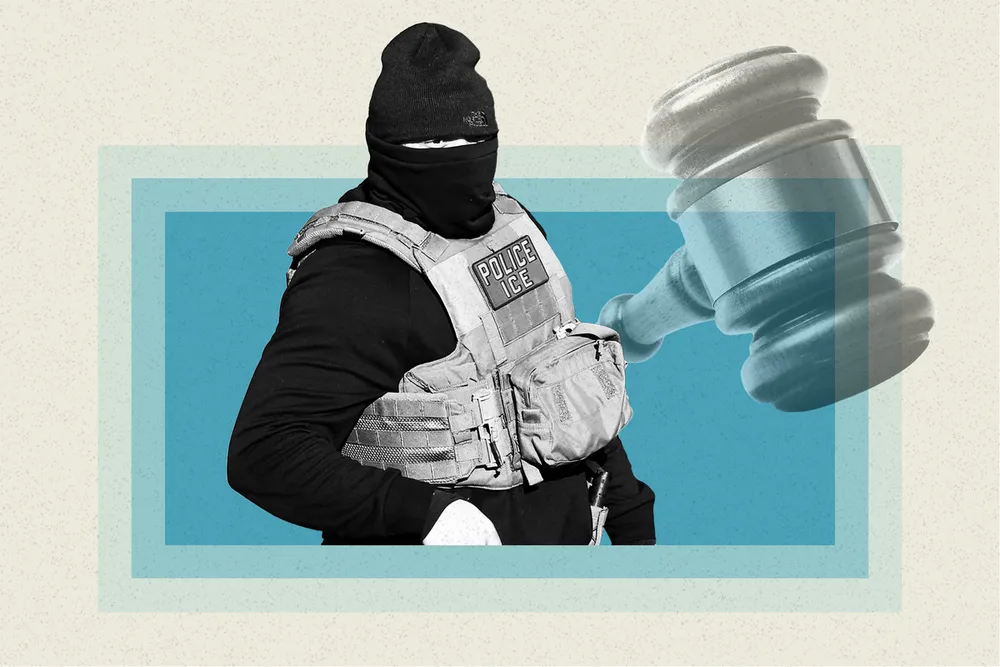
The smallest details index the larger pattern. In one case, a federal judge spent court time tracking a UPS shipment to ensure that an ordered-released man recovered his identification documents. The act of judging began to include the act of physically supervising whether the executive branch’s compliance had occurred.
The judges quoted are increasingly drafting orders prescriptive enough to leave no room for interpretation. Whether prescriptive orders prove harder to evade than non-prescriptive ones is, on the record so far, uncertain.
Read original →
Eighteen Days for Being Latino
Feb 17, 2026 ·
BlueSky, Mark Joseph Stern
A 20-year-old lawfully present in the United States was arrested for being Latino and held for eighteen days in a Minnesota detention cell so cramped he couldn't sit down — an arrest the federal courts have since ruled unlawful.
A 20-year-old who was lawfully present in the United States was arrested in Minnesota by federal agents for what was, on review, the legally unprotected ground of being Latino. He was held for eighteen days in a detention cell described as too cramped for him to sit down. Federal courts have since ruled the arrest and detention unlawful.
Each element of the sequence — the arrest, the conditions, the duration — became a separately reviewable claim. None of those reviews undid the eighteen days.
Read original →
When the Cameras Came Out
Feb 21, 2026 ·
The Guardian
Federal prosecutions of protesters and others accused of 'assaulting' or 'impeding' federal officers have repeatedly collapsed when courtroom evidence — particularly video — contradicted the officers' sworn statements.
Department of Justice prosecutions of protesters, immigrants, and bystanders accused of “assaulting” or “impeding” federal officers during immigration operations have collapsed in court at a rate that has begun to alarm even the prosecutors. Cases have been dismissed or ended in not-guilty verdicts after video evidence contradicted the officers’ sworn accounts. In one Minnesota case, a protester accused of assaulting an ICE officer was cleared when footage showed no assault had occurred. In a Los Angeles case, charges against a protester accused of striking an ICE officer with a hat were dropped after a federal judge ruled the government had acted in “bad faith.”
The pattern documents a specific operational dependency. The government’s enforcement strategy has relied on uncorroborated officer statements as the basis for federal charges. Where such statements have met contemporaneous video, the charges have not survived.
The defendants whose cases were dismissed are not made whole by the dismissal. The arrests, the bookings, the legal fees, the time in detention or under bond conditions — these stand whether or not the officer’s account is ultimately credited.
Read original →
Trained to Disregard
Feb 23, 2026 ·
BlueSky, Molly Ploofkins
ICE whistleblower Ryan Schwank, a former agency instructor and staff attorney, testified that field agents were trained to disregard constitutional rights — making rights violations a matter of policy rather than aberration.
ICE whistleblower Ryan Schwank, a former agency instructor and staff attorney, testified that field agents were trained to disregard constitutional rights as a matter of operational policy. Schwank’s account moves the question of unlawful arrests, denied counsel access, and warrantless entries from the category of individual misconduct into the category of institutional design.
The institutional framing matters because the remedies are different. Individual misconduct can be addressed by discipline; institutional design requires changing the training, the policies, and the people who set them.
Read original →
Arrested for Silent Challenge
Feb 25, 2026 ·
BlueSky, Gabe Ortíz
Aliya Rahman, who was violently dragged from her car by federal agents in January, was arrested again at the State of the Union — the cited reason being that she had silently challenged the president during the speech.
Aliya Rahman, the Minnesotan who was violently dragged out of her car by federal agents in January, was arrested again at the State of the Union address. The stated reason was that Rahman had “silently” challenged the president during the speech.
Silence, in legal terms, is the most protected form of expression. The arrest test was therefore not whether Rahman had spoken, disrupted, or violated any specific rule, but whether her presence and bearing were tolerable to the official mood of the room.
Read original →
Adding to the War Crimes File
Mar 2, 2026 ·
BlueSky, David Kaye
Reading the Secretary of Defense's public statement that the mission would not be 'guided by rules rooted in the law of armed conflict,' former UN special rapporteur David Kaye flagged the declaration as material for any future war crimes prosecution.
The Secretary of Defense’s public statement that the mission would not be “guided by rules rooted in the law of armed conflict” amounted, on its face, to a public declaration that jus in bello principles were inapplicable to the operation. International law professor David Kaye, a former UN Special Rapporteur, flagged the statement as a near-textbook entry for any eventual war crimes prosecution file.
The reason such statements have evidentiary weight is not that they prove a specific war crime; it is that they document the leadership’s stated intent to operate outside the legal framework that defines those crimes. Prosecutors looking for proof of mens rea years from now will find such public declarations harder to misinterpret than internal cables.
Read original →
Thirteen Thousand Sent Anywhere But Home
Mar 21, 2026 ·
BlueSky, Aaron Reichlin-Melnick
Thirteen thousand people have been removed under the third-country deportation framework — many under removal orders issued decades earlier that prior administrations would not have enforced this way.
Through early 2026, thirteen thousand people had been removed from the United States under the third-country deportation framework — many of them subject to removal orders issued decades or generations earlier and never previously enforced this way. The destinations were not the deportees’ countries of origin but whatever third countries could be persuaded or coerced to receive them.
The legal authority for such removals is contested but technically existent. What is genuinely new is the willingness to use it at scale, combined with the choice of destination. Previous administrations encountered the same dormant orders and the same statutory tools and concluded — generally without articulating the reasoning — that the cost in destabilized lives, in deaths in unfamiliar countries, and in international relationships was not worth the enforcement gain. That cost-benefit calculation has been reversed.
Read original →
The Memo That Said What ICE Already Did
Mar 25, 2026 ·
The American Prospect
The legal memo ICE used for more than a year to justify courthouse arrests does not, on its face, grant that authority — a fact ICE's own counsel has now confirmed in writing to the Southern District of New York.
Since May 2025, Immigration and Customs Enforcement officers have been arresting undocumented people as they showed up for routine immigration court hearings at federal buildings such as 26 Federal Plaza in New York. The agency justified the practice by invoking an internal memo dated May 27, 2025, titled “Civil Immigration Enforcement Actions in or Near Courthouses” — the so-called 2025 ICE Guidance.
A March 2026 letter from Jay Clayton, US Attorney for the Southern District of New York, recorded ICE legal counsel’s admission that the memo “does not and has never applied” to immigration court hearings. The arrests had been ongoing for more than a year by the time that admission was put in writing.
The legal authority pointed to had been a misreading of the agency’s own document. The displaced consequence — the people arrested, processed, removed, or released after the missed hearings — is not retroactive.
Read original →