<?xml version="1.0" encoding="utf-8"?><feed xmlns="http://www.w3.org/2005/Atom" ><generator uri="https://jekyllrb.com/" version="3.10.0">Jekyll</generator><link href="https://lightseed.net/stories/feed.xml" rel="self" type="application/atom+xml" /><link href="https://lightseed.net/" rel="alternate" type="text/html" /><updated>2026-05-01T07:17:14+00:00</updated><id>https://lightseed.net/stories/feed.xml</id><title type="html">Stories of 47 | Stories</title><subtitle>Snapshots of the second Trump administration.</subtitle><entry><title type="html">Tracking the Scale of ICE Detention’s First Year</title><link href="https://lightseed.net/stories/ice-detention-scale-first-year/" rel="alternate" type="text/html" title="Tracking the Scale of ICE Detention’s First Year" /><published>2026-04-22T00:00:00+00:00</published><updated>2026-04-22T00:00:00+00:00</updated><id>https://lightseed.net/stories/ice-detention-scale-first-year</id><content type="html" xml:base="https://lightseed.net/stories/ice-detention-scale-first-year/"><![CDATA[<p>More than 450,000 people moved through Immigration and Customs Enforcement custody in the first fourteen months of the second Trump administration, according to federal detention data through March 2026. The count combines initial bookings and transfers between facilities, exceeding the standing federal detention capacity several times over — a measure of throughput rather than headcount.</p>

<p>Each entry represents a person held, processed, and either released, removed, or transferred onward; the administrative paperwork that distinguishes “detention” from “transfer” is not visible from inside the cell. The data is federal record, not estimate, reconstructed by independent researchers from statistics that immigration enforcement agencies have not chosen to publish in aggregate themselves.</p>]]></content><author><name></name></author><summary type="html"><![CDATA[More than 450,000 people moved through Immigration and Customs Enforcement custody in the first fourteen months of the second Trump administration, according to federal detention data through March 2026. The count combines initial bookings and transfers between facilities, exceeding the standing federal detention capacity several times over — a measure of throughput rather than headcount.]]></summary></entry><entry><title type="html">Survivors of the Don Maca</title><link href="https://lightseed.net/stories/don-maca-survivors/" rel="alternate" type="text/html" title="Survivors of the Don Maca" /><published>2026-04-21T00:00:00+00:00</published><updated>2026-04-21T00:00:00+00:00</updated><id>https://lightseed.net/stories/don-maca-survivors</id><content type="html" xml:base="https://lightseed.net/stories/don-maca-survivors/"><![CDATA[<p>The crew of the Ecuadorian fishing vessel Don Maca were finishing a day of swordfish and albacore lines when a drone strike tore through the boat, shattering glass and injuring several. The crew were subsequently detained by US forces and questioned. The United States has produced no evidence connecting the crew or the vessel to drug trafficking.</p>

<p>The strike is part of what the second Trump administration has framed as a “war on narcoterrorists” — a phrase that operates as a label rather than a definition, and one the administration has not been required to substantiate before each operation. Legal experts and human rights organizations have characterized the resulting attacks, which have killed Ecuadorian, Venezuelan, and Colombian civilians at sea, as extrajudicial killings.</p>

<p>The Don Maca was not the first such vessel attacked, nor has the United States said how many crews remain unaccounted for from prior strikes. The survivors’ testimony exists because this strike did not finish them.</p>]]></content><author><name></name></author><summary type="html"><![CDATA[The crew of the Ecuadorian fishing vessel Don Maca were finishing a day of swordfish and albacore lines when a drone strike tore through the boat, shattering glass and injuring several. The crew were subsequently detained by US forces and questioned. The United States has produced no evidence connecting the crew or the vessel to drug trafficking.]]></summary></entry><entry><title type="html">First Day of the Iran War: An Untested Missile Hit a School</title><link href="https://lightseed.net/stories/untested-missile-iran-war/" rel="alternate" type="text/html" title="First Day of the Iran War: An Untested Missile Hit a School" /><published>2026-03-30T00:00:00+00:00</published><updated>2026-03-30T00:00:00+00:00</updated><id>https://lightseed.net/stories/untested-missile-iran-war</id><content type="html" xml:base="https://lightseed.net/stories/untested-missile-iran-war/"><![CDATA[<p>On the first day of the war with Iran, a US ballistic missile previously unused in combat struck a sports hall, an elementary school, and residential buildings, killing at least twenty-one people including children. None of the targets were military by any conventional definition.</p>

<p>Forensic reconstruction — debris analysis, satellite imagery, civilian witness accounts — placed the strikes in the war’s first hours, when targeting decisions are still being calibrated against doctrine and intelligence is at its least mature. The choice to use an untested weapon in this window compounds the question of whether the targeting was deliberate, mistaken, or indifferent.</p>

<p>Whatever the answer, the dead are dead. The Pentagon has not, as of this writing, published a strike assessment that addresses the civilian harm.</p>]]></content><author><name></name></author><summary type="html"><![CDATA[On the first day of the war with Iran, a US ballistic missile previously unused in combat struck a sports hall, an elementary school, and residential buildings, killing at least twenty-one people including children. None of the targets were military by any conventional definition.]]></summary></entry><entry><title type="html">Hanne Engan, Type 1 Diabetic, Detained</title><link href="https://lightseed.net/stories/engan-greencard-arrest/" rel="alternate" type="text/html" title="Hanne Engan, Type 1 Diabetic, Detained" /><published>2026-03-29T00:00:00+00:00</published><updated>2026-03-29T00:00:00+00:00</updated><id>https://lightseed.net/stories/engan-greencard-arrest</id><content type="html" xml:base="https://lightseed.net/stories/engan-greencard-arrest/"><![CDATA[<p>Hanne Engan is a Norwegian citizen married to an American. When she arrived for her green card interview in downtown San Diego, Immigration and Customs Enforcement officers detained her at the appointment. They separated her from the continuous-glucose monitor she wears for Type 1 diabetes and from her insulin, and transported her to the Otay Mesa Detention Center.</p>

<p><img src="/assets/stories/engan-greencard-arrest/img-ae23dc338194f471.jpg" alt="Article preview: &quot;San Diego woman says her credit card information was stolen while she was in ICE custody&quot; — Daylight San Diego." /></p>

<p>Engan’s diabetes escalated rapidly under the conditions of confinement. Without her monitor or her insulin she was, by her own account, near death on multiple occasions during her detention; staff response to her medical condition was both delayed and inadequate. After her eventual release she discovered, separately, that her credit-card information had been used while she was in custody.</p>]]></content><author><name></name></author><summary type="html"><![CDATA[Hanne Engan is a Norwegian citizen married to an American. When she arrived for her green card interview in downtown San Diego, Immigration and Customs Enforcement officers detained her at the appointment. They separated her from the continuous-glucose monitor she wears for Type 1 diabetes and from her insulin, and transported her to the Otay Mesa Detention Center.]]></summary></entry><entry><title type="html">The First Bumbling Raid</title><link href="https://lightseed.net/stories/dhs-lies-series-thao/" rel="alternate" type="text/html" title="The First Bumbling Raid" /><published>2026-03-28T00:00:00+00:00</published><updated>2026-03-28T00:00:00+00:00</updated><id>https://lightseed.net/stories/dhs-lies-series-thao</id><content type="html" xml:base="https://lightseed.net/stories/dhs-lies-series-thao/"><![CDATA[<p>Investigative journalist Radley Balko launched an ongoing series cataloguing the false official statements that the Department of Homeland Security has issued after specific acts of abuse or violence by Immigration and Customs Enforcement and Border Patrol officers in the field. The first installment examines the illegal raid on ChongLy Scott Thao and his family — a raid the agency described publicly in terms that contradicted its own paperwork.</p>

<p><img src="/assets/stories/dhs-lies-series-thao/img-b487ba316c582381.jpg" alt="Substack article preview titled &quot;You Can't Hide Your Lying ICE.&quot;" /></p>

<p>The series itself is the substance: any single instance of an agency lying about a botched operation can be dismissed as anomaly; a methodical accumulation of cases, each documented from the public record, is a different kind of evidence. The cataloguing converts what looks like noise into pattern.</p>]]></content><author><name></name></author><summary type="html"><![CDATA[Investigative journalist Radley Balko launched an ongoing series cataloguing the false official statements that the Department of Homeland Security has issued after specific acts of abuse or violence by Immigration and Customs Enforcement and Border Patrol officers in the field. The first installment examines the illegal raid on ChongLy Scott Thao and his family — a raid the agency described publicly in terms that contradicted its own paperwork.]]></summary></entry><entry><title type="html">Four Out of Five Chemotherapy Sessions</title><link href="https://lightseed.net/stories/lothirath-cancer-detention/" rel="alternate" type="text/html" title="Four Out of Five Chemotherapy Sessions" /><published>2026-03-26T00:00:00+00:00</published><updated>2026-03-26T00:00:00+00:00</updated><id>https://lightseed.net/stories/lothirath-cancer-detention</id><content type="html" xml:base="https://lightseed.net/stories/lothirath-cancer-detention/"><![CDATA[<p>Oudone Lothirath, a Minnesota resident undergoing chemotherapy for aggressive lymphoma, was taken into Immigration and Customs Enforcement custody in January and held in a Texas facility. Of the five chemotherapy sessions scheduled during the period of his detention, he missed four. He received no medical care while in custody. After ten days, ICE released him — not in response to a lawsuit but to a letter from M Health Fairview stating that he would “succumb” without ongoing treatment. The Department of Homeland Security has dismissed reports of inadequate medical care as “false.”</p>

<p>Lothirath was hospitalized on arrival in the Twin Cities with a bladder infection and sepsis. A scan in March showed the lymphoma had spread into his bone marrow during the interruption. He entered hospice on March 20. The article notes that his case is unusually well-documented — his caregiver kept correspondence; the hospital wrote a letter on the record — but situates it within a broader pattern of GoFundMe pages, untreated injuries, denied medications, and missed surgeries that other detained immigrants have left behind in fragments.</p>]]></content><author><name></name></author><summary type="html"><![CDATA[Oudone Lothirath, a Minnesota resident undergoing chemotherapy for aggressive lymphoma, was taken into Immigration and Customs Enforcement custody in January and held in a Texas facility. Of the five chemotherapy sessions scheduled during the period of his detention, he missed four. He received no medical care while in custody. After ten days, ICE released him — not in response to a lawsuit but to a letter from M Health Fairview stating that he would “succumb” without ongoing treatment. The Department of Homeland Security has dismissed reports of inadequate medical care as “false.”]]></summary></entry><entry><title type="html">Inside Dilley</title><link href="https://lightseed.net/stories/dilley-family-detention/" rel="alternate" type="text/html" title="Inside Dilley" /><published>2026-03-26T00:00:00+00:00</published><updated>2026-03-26T00:00:00+00:00</updated><id>https://lightseed.net/stories/dilley-family-detention</id><content type="html" xml:base="https://lightseed.net/stories/dilley-family-detention/"><![CDATA[<p>The Dilley Immigration Processing Center in south Texas — closed by the Biden administration in 2024, reopened in 2025 as part of a forty-five-billion-dollar detention expansion — is the only ICE family detention facility in the country. It is run for ICE by the private prison corporation CoreCivic. Journalists are not permitted inside; congressional oversight visits, until earlier this month, required a week’s advance application. The body of evidence about life inside is therefore almost entirely indirect: sworn declarations submitted by detained children and parents to legal aid groups, some of them filed as exhibits in litigation, others collected by RAICES simply for the record.</p>

<p>Those declarations describe food that has caused a woman to vomit blood, denied or delayed medical and mental-health care, sleeping conditions that resist sleep, intimidation by guards, and a four-year-old who hit his head, developed a black eye, and was not assessed for concussion. DHS and CoreCivic have published websites refuting the claims. The methodological difficulty of testing those refutations — when journalists are barred and detainees’ communications are constrained — is itself part of the story. The closure of the channels through which evidence would normally be examined is what permits the official denials to operate as the only public record from inside the facility.</p>]]></content><author><name></name></author><summary type="html"><![CDATA[The Dilley Immigration Processing Center in south Texas — closed by the Biden administration in 2024, reopened in 2025 as part of a forty-five-billion-dollar detention expansion — is the only ICE family detention facility in the country. It is run for ICE by the private prison corporation CoreCivic. Journalists are not permitted inside; congressional oversight visits, until earlier this month, required a week’s advance application. The body of evidence about life inside is therefore almost entirely indirect: sworn declarations submitted by detained children and parents to legal aid groups, some of them filed as exhibits in litigation, others collected by RAICES simply for the record.]]></summary></entry><entry><title type="html">When the Body Cameras Caught the Chase</title><link href="https://lightseed.net/stories/border-patrol-chicago-chase/" rel="alternate" type="text/html" title="When the Body Cameras Caught the Chase" /><published>2026-03-26T00:00:00+00:00</published><updated>2026-03-26T00:00:00+00:00</updated><id>https://lightseed.net/stories/border-patrol-chicago-chase</id><content type="html" xml:base="https://lightseed.net/stories/border-patrol-chicago-chase/"><![CDATA[<p>Body camera footage of an October 2025 incident in Chicago’s East Side neighborhood shows three named Border Patrol agents continuing an eighteen-minute high-speed vehicle pursuit after their supervisor ordered them to call it off. The chase ended when the agents’ own vehicle blew a tire and crashed. The agents then deployed tear gas in the surrounding residential neighborhood.</p>

<p>The Department of Homeland Security’s official account had described the crash as the result of agents intentionally striking the fleeing vehicle to stop it. The footage reveals neither the deliberate strike nor the intentional choice, but instead a tire failure following a chase that should have ended several minutes earlier.</p>

<p>Three agents are named in the reviews. Whether the gap between the official account and the visual record will produce any consequence for those agents is, as of this writing, unresolved.</p>]]></content><author><name></name></author><summary type="html"><![CDATA[Body camera footage of an October 2025 incident in Chicago’s East Side neighborhood shows three named Border Patrol agents continuing an eighteen-minute high-speed vehicle pursuit after their supervisor ordered them to call it off. The chase ended when the agents’ own vehicle blew a tire and crashed. The agents then deployed tear gas in the surrounding residential neighborhood.]]></summary></entry><entry><title type="html">The Memo That Said What ICE Already Did</title><link href="https://lightseed.net/stories/ice-courthouse-authority-memo/" rel="alternate" type="text/html" title="The Memo That Said What ICE Already Did" /><published>2026-03-25T00:00:00+00:00</published><updated>2026-03-25T00:00:00+00:00</updated><id>https://lightseed.net/stories/ice-courthouse-authority-memo</id><content type="html" xml:base="https://lightseed.net/stories/ice-courthouse-authority-memo/"><![CDATA[<p>Since May 2025, Immigration and Customs Enforcement officers have been arresting undocumented people as they showed up for routine immigration court hearings at federal buildings such as 26 Federal Plaza in New York. The agency justified the practice by invoking an internal memo dated May 27, 2025, titled “Civil Immigration Enforcement Actions in or Near Courthouses” — the so-called 2025 ICE Guidance.</p>

<p>A March 2026 letter from Jay Clayton, US Attorney for the Southern District of New York, recorded ICE legal counsel’s admission that the memo “does not and has never applied” to immigration court hearings. The arrests had been ongoing for more than a year by the time that admission was put in writing.</p>

<p>The legal authority pointed to had been a misreading of the agency’s own document. The displaced consequence — the people arrested, processed, removed, or released after the missed hearings — is not retroactive.</p>]]></content><author><name></name></author><summary type="html"><![CDATA[Since May 2025, Immigration and Customs Enforcement officers have been arresting undocumented people as they showed up for routine immigration court hearings at federal buildings such as 26 Federal Plaza in New York. The agency justified the practice by invoking an internal memo dated May 27, 2025, titled “Civil Immigration Enforcement Actions in or Near Courthouses” — the so-called 2025 ICE Guidance.]]></summary></entry><entry><title type="html">Thirteen Thousand Sent Anywhere But Home</title><link href="https://lightseed.net/stories/thirteen-thousand-sent-anywhere/" rel="alternate" type="text/html" title="Thirteen Thousand Sent Anywhere But Home" /><published>2026-03-21T00:00:00+00:00</published><updated>2026-03-21T00:00:00+00:00</updated><id>https://lightseed.net/stories/thirteen-thousand-sent-anywhere</id><content type="html" xml:base="https://lightseed.net/stories/thirteen-thousand-sent-anywhere/"><![CDATA[<p>Through early 2026, thirteen thousand people had been removed from the United States under the third-country deportation framework — many of them subject to removal orders issued decades or generations earlier and never previously enforced this way. The destinations were not the deportees’ countries of origin but whatever third countries could be persuaded or coerced to receive them.</p>

<p>The legal authority for such removals is contested but technically existent. What is genuinely new is the willingness to use it at scale, combined with the choice of destination. Previous administrations encountered the same dormant orders and the same statutory tools and concluded — generally without articulating the reasoning — that the cost in destabilized lives, in deaths in unfamiliar countries, and in international relationships was not worth the enforcement gain. That cost-benefit calculation has been reversed.</p>]]></content><author><name></name></author><summary type="html"><![CDATA[Through early 2026, thirteen thousand people had been removed from the United States under the third-country deportation framework — many of them subject to removal orders issued decades or generations earlier and never previously enforced this way. The destinations were not the deportees’ countries of origin but whatever third countries could be persuaded or coerced to receive them.]]></summary></entry><entry><title type="html">Twenty-Three Hours</title><link href="https://lightseed.net/stories/paktyawal-afghan-asylum-death/" rel="alternate" type="text/html" title="Twenty-Three Hours" /><published>2026-03-16T00:00:00+00:00</published><updated>2026-03-16T00:00:00+00:00</updated><id>https://lightseed.net/stories/paktyawal-afghan-asylum-death</id><content type="html" xml:base="https://lightseed.net/stories/paktyawal-afghan-asylum-death/"><![CDATA[<p>Mohommad Nazeer Paktyawal, age forty-one, was preparing to take his children to school on a Friday morning when a group of masked men drove up to his apartment complex in Richardson, Texas, and placed him in handcuffs. He had worked alongside the US military in Afghanistan, had no known health conditions, and was applying for US asylum. He died in Immigration and Customs Enforcement custody less than twenty-four hours after his arrest.</p>

<p>ICE described the deceased man, in its initial public statement, as a “criminal illegal alien from Afghanistan” and said the cause of death was under investigation. The phrase “criminal illegal alien” was not accompanied by reference to any specific charge, conviction, or proceeding.</p>

<p>Paktyawal left six children. He was not in custody long enough for any of the procedural mechanisms the United States nominally extends to asylum applicants to begin to function.</p>]]></content><author><name></name></author><summary type="html"><![CDATA[Mohommad Nazeer Paktyawal, age forty-one, was preparing to take his children to school on a Friday morning when a group of masked men drove up to his apartment complex in Richardson, Texas, and placed him in handcuffs. He had worked alongside the US military in Afghanistan, had no known health conditions, and was applying for US asylum. He died in Immigration and Customs Enforcement custody less than twenty-four hours after his arrest.]]></summary></entry><entry><title type="html">The Sons’ New Drone Company</title><link href="https://lightseed.net/stories/trump-sons-drone-company/" rel="alternate" type="text/html" title="The Sons’ New Drone Company" /><published>2026-03-09T00:00:00+00:00</published><updated>2026-03-09T00:00:00+00:00</updated><id>https://lightseed.net/stories/trump-sons-drone-company</id><content type="html" xml:base="https://lightseed.net/stories/trump-sons-drone-company/"><![CDATA[<p>Eric Trump and Donald Trump Jr. are backers of a new drone company whose business plan, on the public record, is winning Pentagon procurement contracts. Their father is the sitting president of the United States, who controls the executive branch within which the Department of Defense awards those contracts.</p>

<p><img src="/assets/stories/trump-sons-drone-company/img-0297a35e8b785645.jpg" alt="Article preview: &quot;Trump Sons Back New Drone Company Targeting Pentagon Sales&quot; — The Wall Street Journal." /></p>

<p>The structural conflict needs no decoding: a defense vendor whose senior backers are children of the commander-in-chief, competing for contracts let by his administration. The arrangement is what the federal anti-emoluments architecture, written across the Constitution and various statutes, was designed to prevent — though enforcement of those provisions has, since 2017, depended primarily on shame.</p>]]></content><author><name></name></author><summary type="html"><![CDATA[Eric Trump and Donald Trump Jr. are backers of a new drone company whose business plan, on the public record, is winning Pentagon procurement contracts. Their father is the sitting president of the United States, who controls the executive branch within which the Department of Defense awards those contracts.]]></summary></entry><entry><title type="html">The Pool</title><link href="https://lightseed.net/stories/east-montana-suicide-bets/" rel="alternate" type="text/html" title="The Pool" /><published>2026-03-07T00:00:00+00:00</published><updated>2026-03-07T00:00:00+00:00</updated><id>https://lightseed.net/stories/east-montana-suicide-bets</id><content type="html" xml:base="https://lightseed.net/stories/east-montana-suicide-bets/"><![CDATA[<p>According to Associated Press reporting based on 911 call logs and detainee accounts, staff at Camp East Montana — the nation’s largest Immigration and Customs Enforcement detention facility, holding around three thousand people in tents on Fort Bliss in El Paso, Texas — operated a betting pool on which detainee would next die by suicide. Owen Ramsingh, a legal permanent resident held there for several weeks, told the AP that he overheard a guard say he had paid five hundred dollars into the pot, with payouts going to the staff member with the most accurate predictions. DHS told the AP that Ramsingh, who was brought to the United States from the Netherlands at age five, was lying. In January, the facility called 911 for Geraldo Lunas Campos, a fifty-five-year-old Cuban man; DHS reported it as an attempted suicide, but a medical examiner ruled the death a homicide. That same month, a thirty-six-year-old Nicaraguan man at the facility died by suicide.</p>

<p>The site itself is significant: Camp East Montana stands where Fort Bliss housed Japanese Americans during World War II. The AP’s review documents one hundred and thirty 911 calls in the first roughly five months of operation, including at least six additional self-harm incidents serious enough to require emergency response. The betting pool, if it operated as Ramsingh described, was therefore betting on a frequent enough event that wagering on its next instance was a structurally coherent activity for guards to organize.</p>]]></content><author><name></name></author><summary type="html"><![CDATA[According to Associated Press reporting based on 911 call logs and detainee accounts, staff at Camp East Montana — the nation’s largest Immigration and Customs Enforcement detention facility, holding around three thousand people in tents on Fort Bliss in El Paso, Texas — operated a betting pool on which detainee would next die by suicide. Owen Ramsingh, a legal permanent resident held there for several weeks, told the AP that he overheard a guard say he had paid five hundred dollars into the pot, with payouts going to the staff member with the most accurate predictions. DHS told the AP that Ramsingh, who was brought to the United States from the Netherlands at age five, was lying. In January, the facility called 911 for Geraldo Lunas Campos, a fifty-five-year-old Cuban man; DHS reported it as an attempted suicide, but a medical examiner ruled the death a homicide. That same month, a thirty-six-year-old Nicaraguan man at the facility died by suicide.]]></summary></entry><entry><title type="html">Adding to the War Crimes File</title><link href="https://lightseed.net/stories/war-crimes-file/" rel="alternate" type="text/html" title="Adding to the War Crimes File" /><published>2026-03-02T00:00:00+00:00</published><updated>2026-03-02T00:00:00+00:00</updated><id>https://lightseed.net/stories/war-crimes-file</id><content type="html" xml:base="https://lightseed.net/stories/war-crimes-file/"><![CDATA[<p>The Secretary of Defense’s public statement that the mission would not be “guided by rules rooted in the law of armed conflict” amounted, on its face, to a public declaration that <em>jus in bello</em> principles were inapplicable to the operation. International law professor David Kaye, a former UN Special Rapporteur, flagged the statement as a near-textbook entry for any eventual war crimes prosecution file.</p>

<p>The reason such statements have evidentiary weight is not that they prove a specific war crime; it is that they document the leadership’s stated intent to operate outside the legal framework that defines those crimes. Prosecutors looking for proof of <em>mens rea</em> years from now will find such public declarations harder to misinterpret than internal cables.</p>]]></content><author><name></name></author><summary type="html"><![CDATA[The Secretary of Defense’s public statement that the mission would not be “guided by rules rooted in the law of armed conflict” amounted, on its face, to a public declaration that jus in bello principles were inapplicable to the operation. International law professor David Kaye, a former UN Special Rapporteur, flagged the statement as a near-textbook entry for any eventual war crimes prosecution file.]]></summary></entry><entry><title type="html">Arrested for Silent Challenge</title><link href="https://lightseed.net/stories/rahman-sotu-arrest/" rel="alternate" type="text/html" title="Arrested for Silent Challenge" /><published>2026-02-25T00:00:00+00:00</published><updated>2026-02-25T00:00:00+00:00</updated><id>https://lightseed.net/stories/rahman-sotu-arrest</id><content type="html" xml:base="https://lightseed.net/stories/rahman-sotu-arrest/"><![CDATA[<p>Aliya Rahman, the Minnesotan who was violently dragged out of her car by federal agents in January, was arrested again at the State of the Union address. The stated reason was that Rahman had “silently” challenged the president during the speech.</p>

<p>Silence, in legal terms, is the most protected form of expression. The arrest test was therefore not whether Rahman had spoken, disrupted, or violated any specific rule, but whether her presence and bearing were tolerable to the official mood of the room.</p>]]></content><author><name></name></author><summary type="html"><![CDATA[Aliya Rahman, the Minnesotan who was violently dragged out of her car by federal agents in January, was arrested again at the State of the Union address. The stated reason was that Rahman had “silently” challenged the president during the speech.]]></summary></entry><entry><title type="html">The Only Other Witness</title><link href="https://lightseed.net/stories/only-other-witness/" rel="alternate" type="text/html" title="The Only Other Witness" /><published>2026-02-24T00:00:00+00:00</published><updated>2026-02-24T00:00:00+00:00</updated><id>https://lightseed.net/stories/only-other-witness</id><content type="html" xml:base="https://lightseed.net/stories/only-other-witness/"><![CDATA[<p>The only passenger in the car when an ICE officer shot and killed a United States citizen in Texas in 2025 was Joshua Orta. Orta had planned to speak publicly and contradict the government’s official account of the shooting. He died in an unrelated car crash before he could do so.</p>

<p>The word “unrelated” is doing all the work in the sentence above, and the only thing the public has to support it is the absence of contradicting evidence. In a case where the contested fact is the killing of a United States citizen by a federal officer, the absence of contradicting evidence is no longer a neutral state.</p>]]></content><author><name></name></author><summary type="html"><![CDATA[The only passenger in the car when an ICE officer shot and killed a United States citizen in Texas in 2025 was Joshua Orta. Orta had planned to speak publicly and contradict the government’s official account of the shooting. He died in an unrelated car crash before he could do so.]]></summary></entry><entry><title type="html">Trained to Disregard</title><link href="https://lightseed.net/stories/ice-trained-to-disregard/" rel="alternate" type="text/html" title="Trained to Disregard" /><published>2026-02-23T00:00:00+00:00</published><updated>2026-02-23T00:00:00+00:00</updated><id>https://lightseed.net/stories/ice-trained-to-disregard</id><content type="html" xml:base="https://lightseed.net/stories/ice-trained-to-disregard/"><![CDATA[<p>ICE whistleblower Ryan Schwank, a former agency instructor and staff attorney, testified that field agents were trained to disregard constitutional rights as a matter of operational policy. Schwank’s account moves the question of unlawful arrests, denied counsel access, and warrantless entries from the category of individual misconduct into the category of institutional design.</p>

<p>The institutional framing matters because the remedies are different. Individual misconduct can be addressed by discipline; institutional design requires changing the training, the policies, and the people who set them.</p>]]></content><author><name></name></author><summary type="html"><![CDATA[ICE whistleblower Ryan Schwank, a former agency instructor and staff attorney, testified that field agents were trained to disregard constitutional rights as a matter of operational policy. Schwank’s account moves the question of unlawful arrests, denied counsel access, and warrantless entries from the category of individual misconduct into the category of institutional design.]]></summary></entry><entry><title type="html">When the Cameras Came Out</title><link href="https://lightseed.net/stories/doj-cases-collapsing/" rel="alternate" type="text/html" title="When the Cameras Came Out" /><published>2026-02-21T00:00:00+00:00</published><updated>2026-02-21T00:00:00+00:00</updated><id>https://lightseed.net/stories/doj-cases-collapsing</id><content type="html" xml:base="https://lightseed.net/stories/doj-cases-collapsing/"><![CDATA[<p>Department of Justice prosecutions of protesters, immigrants, and bystanders accused of “assaulting” or “impeding” federal officers during immigration operations have collapsed in court at a rate that has begun to alarm even the prosecutors. Cases have been dismissed or ended in not-guilty verdicts after video evidence contradicted the officers’ sworn accounts. In one Minnesota case, a protester accused of assaulting an ICE officer was cleared when footage showed no assault had occurred. In a Los Angeles case, charges against a protester accused of striking an ICE officer with a hat were dropped after a federal judge ruled the government had acted in “bad faith.”</p>

<p>The pattern documents a specific operational dependency. The government’s enforcement strategy has relied on uncorroborated officer statements as the basis for federal charges. Where such statements have met contemporaneous video, the charges have not survived.</p>

<p>The defendants whose cases were dismissed are not made whole by the dismissal. The arrests, the bookings, the legal fees, the time in detention or under bond conditions — these stand whether or not the officer’s account is ultimately credited.</p>]]></content><author><name></name></author><summary type="html"><![CDATA[Department of Justice prosecutions of protesters, immigrants, and bystanders accused of “assaulting” or “impeding” federal officers during immigration operations have collapsed in court at a rate that has begun to alarm even the prosecutors. Cases have been dismissed or ended in not-guilty verdicts after video evidence contradicted the officers’ sworn accounts. In one Minnesota case, a protester accused of assaulting an ICE officer was cleared when footage showed no assault had occurred. In a Los Angeles case, charges against a protester accused of striking an ICE officer with a hat were dropped after a federal judge ruled the government had acted in “bad faith.”]]></summary></entry><entry><title type="html">Not Accidental</title><link href="https://lightseed.net/stories/deaths-by-design/" rel="alternate" type="text/html" title="Not Accidental" /><published>2026-02-19T00:00:00+00:00</published><updated>2026-02-19T00:00:00+00:00</updated><id>https://lightseed.net/stories/deaths-by-design</id><content type="html" xml:base="https://lightseed.net/stories/deaths-by-design/"><![CDATA[<p>Deaths in US immigration detention now match the patterns recorded in the early phases of past regimes’ concentration-camp systems: deaths from poor conditions, untreated disease, untreated injury, and abuse. The pattern is not random misfortune. It is the predictable output of a custodial system whose design parameters — overcrowding, medical neglect, indefinite holds, restricted oversight — produce deaths as a statistically expected result.</p>

<p>The historical analogy is not rhetorical. It is a description of what happens when the same operational choices are made.</p>]]></content><author><name></name></author><summary type="html"><![CDATA[Deaths in US immigration detention now match the patterns recorded in the early phases of past regimes’ concentration-camp systems: deaths from poor conditions, untreated disease, untreated injury, and abuse. The pattern is not random misfortune. It is the predictable output of a custodial system whose design parameters — overcrowding, medical neglect, indefinite holds, restricted oversight — produce deaths as a statistically expected result.]]></summary></entry><entry><title type="html">Seventy-Three Percent</title><link href="https://lightseed.net/stories/ice-bookings-no-convictions/" rel="alternate" type="text/html" title="Seventy-Three Percent" /><published>2026-02-18T00:00:00+00:00</published><updated>2026-02-18T00:00:00+00:00</updated><id>https://lightseed.net/stories/ice-bookings-no-convictions</id><content type="html" xml:base="https://lightseed.net/stories/ice-bookings-no-convictions/"><![CDATA[<p>Of the people booked into Immigration and Customs Enforcement custody between October 1, 2025 and the date of the available data, seventy-three percent had no criminal conviction of any kind. Eight percent had a conviction for a violent or property offense. The remaining nineteen percent had been convicted of something — most commonly an immigration-related offense, including the act of unlawful presence itself.</p>

<p><img src="/assets/stories/ice-bookings-no-convictions/img-bf634e22ec4a8c90.jpg" alt="Article preview: &quot;Tricia McLaughlin's Top Five Lies&quot; — The Bulwark." /></p>

<p>The figure cannot be reconciled with the administration’s repeated framing of mass enforcement as targeted toward “the worst of the worst” or “criminal illegal aliens.” The framing requires that the people in custody be the people the framing describes; the data show, to a near-three-quarters majority, that they are not.</p>]]></content><author><name></name></author><summary type="html"><![CDATA[Of the people booked into Immigration and Customs Enforcement custody between October 1, 2025 and the date of the available data, seventy-three percent had no criminal conviction of any kind. Eight percent had a conviction for a violent or property offense. The remaining nineteen percent had been convicted of something — most commonly an immigration-related offense, including the act of unlawful presence itself.]]></summary></entry><entry><title type="html">The Procurement Officer’s Former Employer</title><link href="https://lightseed.net/stories/geo-group-ice-procurement/" rel="alternate" type="text/html" title="The Procurement Officer’s Former Employer" /><published>2026-02-17T00:00:00+00:00</published><updated>2026-02-17T00:00:00+00:00</updated><id>https://lightseed.net/stories/geo-group-ice-procurement</id><content type="html" xml:base="https://lightseed.net/stories/geo-group-ice-procurement/"><![CDATA[<p>The federal official directing Immigration and Customs Enforcement’s detention procurement is David Venturella, a former executive of GEO Group, where he ran the company’s immigration detention portfolio. The Department of Homeland Security granted him a written ethics waiver permitting him to award contracts to his prior employer in his new role.</p>

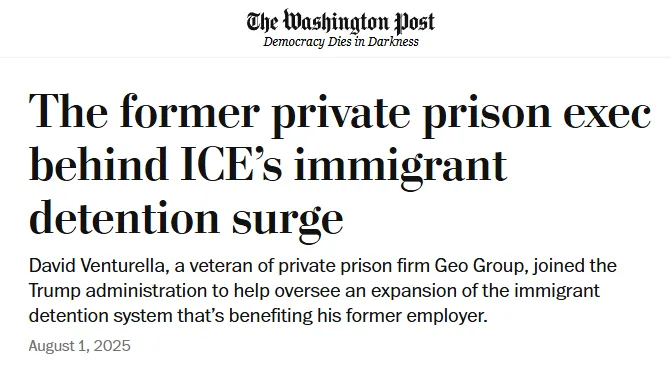
<p><img src="/assets/stories/geo-group-ice-procurement/img-32e8f4da316e1e16.jpg" alt="Screenshot from a Washington Post profile of David Venturella with the headline &quot;The former private prison exec behind ICE's immigrant detention surge.&quot;" /></p>

<p>The waiver has functioned. GEO’s principal access to ICE money runs through a complex Navy procurement system used to disburse most of the $45 billion the Navy distributed last year, allowing ICE to direct contracts to GEO without competitive bids. GEO’s competitors — other private detention operators eyeing the same expanding market — have not received comparable channels of access.</p>

<p>By industry estimate, GEO Group is positioned to receive tens of billions of federal dollars over the next four years for detaining immigrants. The procurement officer who directs those contracts came directly from the company that receives them.</p>]]></content><author><name></name></author><summary type="html"><![CDATA[The federal official directing Immigration and Customs Enforcement’s detention procurement is David Venturella, a former executive of GEO Group, where he ran the company’s immigration detention portfolio. The Department of Homeland Security granted him a written ethics waiver permitting him to award contracts to his prior employer in his new role.]]></summary></entry><entry><title type="html">Eighteen Days for Being Latino</title><link href="https://lightseed.net/stories/eighteen-days-for-being-latino/" rel="alternate" type="text/html" title="Eighteen Days for Being Latino" /><published>2026-02-17T00:00:00+00:00</published><updated>2026-02-17T00:00:00+00:00</updated><id>https://lightseed.net/stories/eighteen-days-for-being-latino</id><content type="html" xml:base="https://lightseed.net/stories/eighteen-days-for-being-latino/"><![CDATA[<p>A 20-year-old who was lawfully present in the United States was arrested in Minnesota by federal agents for what was, on review, the legally unprotected ground of being Latino. He was held for eighteen days in a detention cell described as too cramped for him to sit down. Federal courts have since ruled the arrest and detention unlawful.</p>

<p>Each element of the sequence — the arrest, the conditions, the duration — became a separately reviewable claim. None of those reviews undid the eighteen days.</p>]]></content><author><name></name></author><summary type="html"><![CDATA[A 20-year-old who was lawfully present in the United States was arrested in Minnesota by federal agents for what was, on review, the legally unprotected ground of being Latino. He was held for eighteen days in a detention cell described as too cramped for him to sit down. Federal courts have since ruled the arrest and detention unlawful.]]></summary></entry><entry><title type="html">After the Letters Were Published</title><link href="https://lightseed.net/stories/after-the-letters/" rel="alternate" type="text/html" title="After the Letters Were Published" /><published>2026-02-17T00:00:00+00:00</published><updated>2026-02-17T00:00:00+00:00</updated><id>https://lightseed.net/stories/after-the-letters</id><content type="html" xml:base="https://lightseed.net/stories/after-the-letters/"><![CDATA[<p>A seven-year-old child from Venezuela, Mia Valentina Paz Faria, was held in the Dilley, Texas family detention camp for seventy days. In a letter to the outside, she wrote: “I don’t want to be in this place I want to go to my school.” Hers was one of several letters that reached ProPublica reporters and was published in the resulting story.</p>

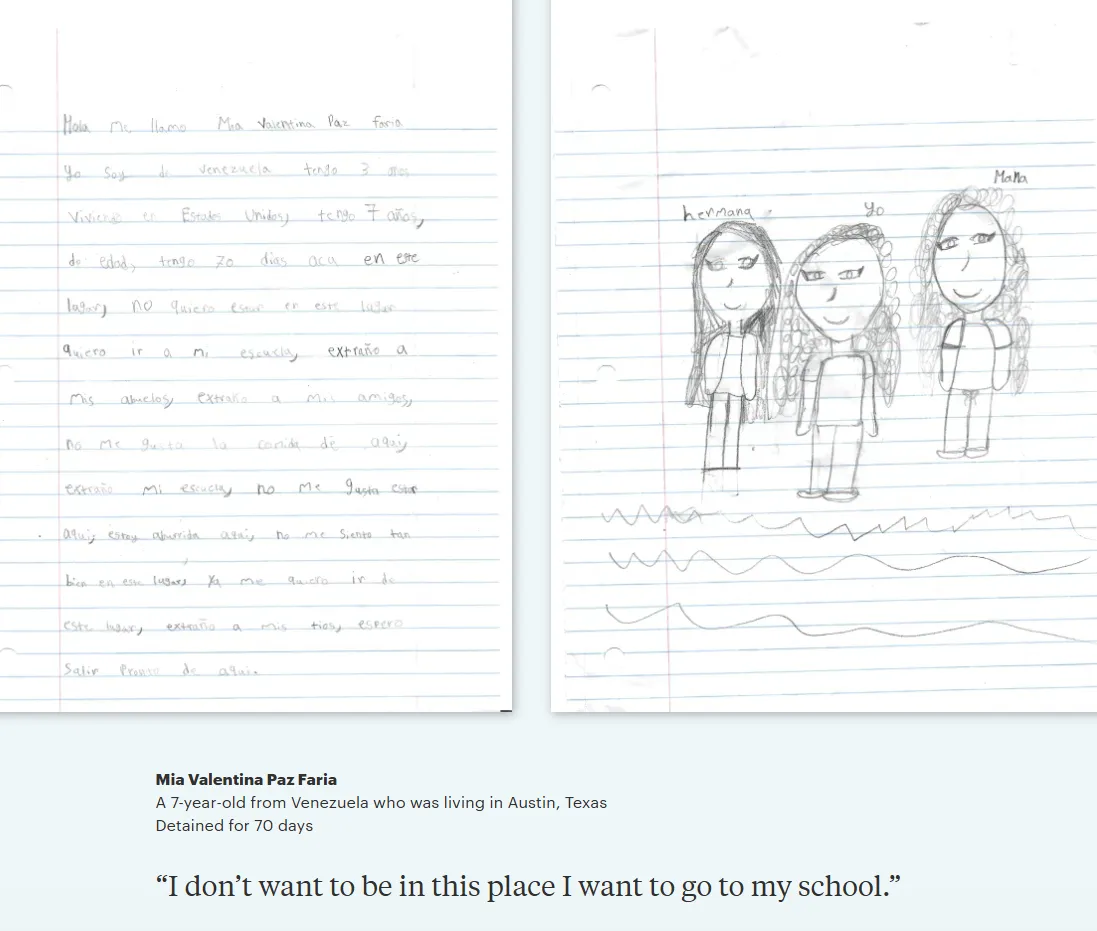
<p><img src="/assets/stories/after-the-letters/img-177341e8d57e831c.jpg" alt="Photograph of Mia Valentina Paz Faria, a 7-year-old from Venezuela who was living in Austin, Texas, detained for 70 days. Caption quotes her: &quot;I don't want to be in this place I want to go to my school.&quot;" /></p>

<p>The published letters carried the voices of multiple children at the same facility. A nine-year-old held one hundred thirteen days wrote, “Me in dilei [Dilley] am not happy please get me out of here to colombia.” A five-year-old wrote two words: “My family.” Mothers at the camp described children who had begun cutting themselves and talking about suicide, and who were finding worms and mold in their food.</p>

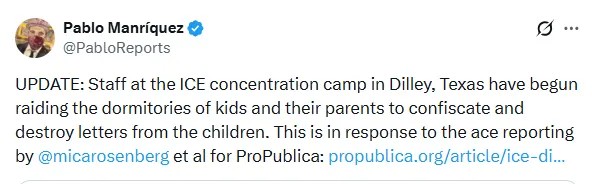
<p>The day the ProPublica story was published, federal personnel raided the camp’s dormitories to confiscate and destroy further letters from the children. The administrative response to the publication was not an investigation of the conditions described, nor an accommodation of the children’s stated wishes, but the elimination of the specific medium that had let those statements escape.</p>

<p><img src="/assets/stories/after-the-letters/img-71666d8cbcc533d0.jpg" alt="Update screenshot stating: &quot;Staff at the ICE concentration camp in Dilley, Texas have begun raiding the dormitories of kids and their parents to confiscate and destroy letters from the children. This is in response to the reporting by Mica Rosenberg et al for ProPublica.&quot;" /></p>]]></content><author><name></name></author><summary type="html"><![CDATA[A seven-year-old child from Venezuela, Mia Valentina Paz Faria, was held in the Dilley, Texas family detention camp for seventy days. In a letter to the outside, she wrote: “I don’t want to be in this place I want to go to my school.” Hers was one of several letters that reached ProPublica reporters and was published in the resulting story.]]></summary></entry><entry><title type="html">The Customer in Question</title><link href="https://lightseed.net/stories/corecivic-dilley-monetization/" rel="alternate" type="text/html" title="The Customer in Question" /><published>2026-02-15T00:00:00+00:00</published><updated>2026-02-15T00:00:00+00:00</updated><id>https://lightseed.net/stories/corecivic-dilley-monetization</id><content type="html" xml:base="https://lightseed.net/stories/corecivic-dilley-monetization/"><![CDATA[<p>On a CoreCivic earnings call in early 2026, CEO Patrick Swindle described Immigration and Customs Enforcement as a “customer” with whom the company maintained “constant dialogue” to evaluate “how we can participate in that” mission. CoreCivic and GEO Group, the two largest private operators of immigration detention facilities in the United States, had reactivated idle capacity in advance of the second Trump administration’s enforcement push. The Dilley, Texas family detention center — where letters from imprisoned children reached ProPublica reporters — is among those reactivated facilities.</p>

<p><img src="/assets/stories/corecivic-dilley-monetization/img-33256c3c962fab2e.jpg" alt="Article preview: &quot;The Kids Trump Sent to ICE's Dilley Detention Center&quot; — ProPublica." /></p>

<p>CoreCivic’s executive compensation is structured to track company earnings. ICE revenues for the company more than doubled in 2025. Investors on the same earnings calls — Raj Sharma of Texas Bank, Matthew Arbner of Jones Trading, Greg Gibas of Northland Securities, Ben Briggs of StoneX Financial, M. Marin of Zacks, Bill Sutherland of Benchmark, Joe Gomes of Noble Capital — were on record expressing frustration that record detention numbers had not climbed higher.</p>

<p>The frustration is the substance. There is, on this analytic frame, no scenario in which a facility designed to hold immigrants is full enough.</p>]]></content><author><name></name></author><summary type="html"><![CDATA[On a CoreCivic earnings call in early 2026, CEO Patrick Swindle described Immigration and Customs Enforcement as a “customer” with whom the company maintained “constant dialogue” to evaluate “how we can participate in that” mission. CoreCivic and GEO Group, the two largest private operators of immigration detention facilities in the United States, had reactivated idle capacity in advance of the second Trump administration’s enforcement push. The Dilley, Texas family detention center — where letters from imprisoned children reached ProPublica reporters — is among those reactivated facilities.]]></summary></entry><entry><title type="html">The Thirty-Eighth Killing</title><link href="https://lightseed.net/stories/thirty-eighth-extrajudicial-killing/" rel="alternate" type="text/html" title="The Thirty-Eighth Killing" /><published>2026-02-10T00:00:00+00:00</published><updated>2026-02-10T00:00:00+00:00</updated><id>https://lightseed.net/stories/thirty-eighth-extrajudicial-killing</id><content type="html" xml:base="https://lightseed.net/stories/thirty-eighth-extrajudicial-killing/"><![CDATA[<p>A running tally compiled from public reporting on US military operations in the Caribbean and elsewhere has recorded its thirty-eighth instance of the United States military unlawfully killing civilians under the orders of the Secretary of Defense and the President. The cumulative count of the dead is at least one hundred thirty. None of those killed were charged with a crime; the identities of most were not known to those who killed them.</p>

<p>The connecting thread visible from outside is the absence of an articulable legal framework. Strikes are described, in announcements when they are announced at all, as targeting “narcoterrorists” or other categorical enemies whose definitions are not given before the fact and whose qualification cannot be examined after. The constraint has shifted from law to assertion.</p>]]></content><author><name></name></author><summary type="html"><![CDATA[A running tally compiled from public reporting on US military operations in the Caribbean and elsewhere has recorded its thirty-eighth instance of the United States military unlawfully killing civilians under the orders of the Secretary of Defense and the President. The cumulative count of the dead is at least one hundred thirty. None of those killed were charged with a crime; the identities of most were not known to those who killed them.]]></summary></entry><entry><title type="html">Five Patterns of Defiance</title><link href="https://lightseed.net/stories/trump-admin-court-defiance/" rel="alternate" type="text/html" title="Five Patterns of Defiance" /><published>2026-02-10T00:00:00+00:00</published><updated>2026-02-10T00:00:00+00:00</updated><id>https://lightseed.net/stories/trump-admin-court-defiance</id><content type="html" xml:base="https://lightseed.net/stories/trump-admin-court-defiance/"><![CDATA[<p>Federal judges adjudicating immigration cases under the second Trump administration have begun publicly cataloguing a pattern of noncompliance with their orders. The list, as enumerated by judges in Minnesota and elsewhere, runs to at least five recurring tactics: detainees rapidly relocated across state lines (often to Texas or New Mexico) before habeas challenges can ripen; court deadlines for response simply ignored, with growing frequency; bail-style “conditions” like GPS monitoring imposed on people the judge has already ordered released; release into the cold or far from home, without identification, wallets, or warm clothes; and bond hearings that fall measurably short of constitutional standards.</p>

<p><img src="/assets/stories/trump-admin-court-defiance/img-73fc2e83a679cf14.jpg" alt="Article preview: &quot;How the Trump administration skirts — and defies — court rulings on ICE detentions&quot; — Politico." /></p>

<p>The smallest details index the larger pattern. In one case, a federal judge spent court time tracking a UPS shipment to ensure that an ordered-released man recovered his identification documents. The act of judging began to include the act of physically supervising whether the executive branch’s compliance had occurred.</p>

<p>The judges quoted are increasingly drafting orders prescriptive enough to leave no room for interpretation. Whether prescriptive orders prove harder to evade than non-prescriptive ones is, on the record so far, uncertain.</p>]]></content><author><name></name></author><summary type="html"><![CDATA[Federal judges adjudicating immigration cases under the second Trump administration have begun publicly cataloguing a pattern of noncompliance with their orders. The list, as enumerated by judges in Minnesota and elsewhere, runs to at least five recurring tactics: detainees rapidly relocated across state lines (often to Texas or New Mexico) before habeas challenges can ripen; court deadlines for response simply ignored, with growing frequency; bail-style “conditions” like GPS monitoring imposed on people the judge has already ordered released; release into the cold or far from home, without identification, wallets, or warm clothes; and bond hearings that fall measurably short of constitutional standards.]]></summary></entry><entry><title type="html">One Hundred and Fifty Leases</title><link href="https://lightseed.net/stories/ice-150-facility-expansion/" rel="alternate" type="text/html" title="One Hundred and Fifty Leases" /><published>2026-02-10T00:00:00+00:00</published><updated>2026-02-10T00:00:00+00:00</updated><id>https://lightseed.net/stories/ice-150-facility-expansion</id><content type="html" xml:base="https://lightseed.net/stories/ice-150-facility-expansion/"><![CDATA[<p>Federal records obtained by WIRED document a months-long, deliberately quiet expansion of Immigration and Customs Enforcement’s physical footprint: more than one hundred and fifty leases and office expansions, in nearly every state, frequently sited near elementary schools, child-care providers, medical offices, and other places the agency itself classifies as sensitive. The General Services Administration, which manages federal real estate, was asked in writing by DHS to disregard normal lease procurement procedures and to conceal listings on grounds of “national security.” A GSA spokesperson, asked, said only that GSA was “following all lease procurement procedures in accordance with all applicable laws and regulations.”</p>

<p>The expansion is the physical correlate of the agency’s funding surge under the One Big Beautiful Bill Act, which directed nearly eighty billion dollars to ICE. The agency has more than doubled in size since January 2025; the offices are where the new agents will work. Reporting on the build-out is not, in itself, a scandal — every federal agency leases office space — but the procurement choices reveal an intent: place the offices where they can be reached quickly, and place them quietly enough that the cities involved cannot organize against them in advance.</p>]]></content><author><name></name></author><summary type="html"><![CDATA[Federal records obtained by WIRED document a months-long, deliberately quiet expansion of Immigration and Customs Enforcement’s physical footprint: more than one hundred and fifty leases and office expansions, in nearly every state, frequently sited near elementary schools, child-care providers, medical offices, and other places the agency itself classifies as sensitive. The General Services Administration, which manages federal real estate, was asked in writing by DHS to disregard normal lease procurement procedures and to conceal listings on grounds of “national security.” A GSA spokesperson, asked, said only that GSA was “following all lease procurement procedures in accordance with all applicable laws and regulations.”]]></summary></entry><entry><title type="html">She Has Not Gone Outside</title><link href="https://lightseed.net/stories/vang-st-paul-return-visits/" rel="alternate" type="text/html" title="She Has Not Gone Outside" /><published>2026-02-03T00:00:00+00:00</published><updated>2026-02-03T00:00:00+00:00</updated><id>https://lightseed.net/stories/vang-st-paul-return-visits</id><content type="html" xml:base="https://lightseed.net/stories/vang-st-paul-return-visits/"><![CDATA[<p>Thi Dua Vang fled Vietnam, where her family had been persecuted for being Christian, with a brother who had been imprisoned for his faith. She lived undocumented in Thailand for more than seven years before the family was granted asylum in the United States in December 2023. She had applied for a green card and was awaiting final approval. On the morning of January 8, six ICE agents came to her family’s St. Paul home; her son opened the door. Vang speaks Hmong; her brother, who interpreted for her, says the agents would not state a reason. She was transferred the next day to El Paso, then to Houston. At one point she was brought onto a runway in a plane she believed was deporting her to Vietnam before being pulled off. After two weeks, an immigration judge ordered her released on bond.</p>

<p>Five days after her release, in compliance with the conditions of her bond, Vang completed a check-in with ICE; she was free to go. Since then, she has not been able to leave her home. She has lost her job. According to her account in the article, ICE agents have continued to come to the house. The release order, the bond, and the legal-status documents — the formal pieces of paper an immigration system is supposed to use to certify that a person is not to be detained again — have not, in her case, foreclosed the possibility of being detained again.</p>]]></content><author><name></name></author><summary type="html"><![CDATA[Thi Dua Vang fled Vietnam, where her family had been persecuted for being Christian, with a brother who had been imprisoned for his faith. She lived undocumented in Thailand for more than seven years before the family was granted asylum in the United States in December 2023. She had applied for a green card and was awaiting final approval. On the morning of January 8, six ICE agents came to her family’s St. Paul home; her son opened the door. Vang speaks Hmong; her brother, who interpreted for her, says the agents would not state a reason. She was transferred the next day to El Paso, then to Houston. At one point she was brought onto a runway in a plane she believed was deporting her to Vietnam before being pulled off. After two weeks, an immigration judge ordered her released on bond.]]></summary></entry><entry><title type="html">The Sheriff Who Spoke Up</title><link href="https://lightseed.net/stories/maine-sheriff-records-subpoena/" rel="alternate" type="text/html" title="The Sheriff Who Spoke Up" /><published>2026-02-03T00:00:00+00:00</published><updated>2026-02-03T00:00:00+00:00</updated><id>https://lightseed.net/stories/maine-sheriff-records-subpoena</id><content type="html" xml:base="https://lightseed.net/stories/maine-sheriff-records-subpoena/"><![CDATA[<p>Kevin Joyce, the sheriff of Cumberland County, Maine, held a press conference during ICE’s January enforcement surge in the state to criticize the agency’s tactics. The day before, federal agents had arrested one of his own corrections officers — Emanuel Ludovic Mbuangi Landila, an Angolan immigrant whom Joyce described as “squeaky clean” and who had passed multiple background checks and held a valid work permit. The day after the press conference, ICE served the county with a subpoena demanding employment data on every person who had worked at the Cumberland County jail since January 2025. The county complied. ICE separately began moving detainees out of the jail, which had housed federal detainees under a long-standing contract; an agency spokesperson said it could no longer partner with a jail that employed an “illegal alien.”</p>

<p>Joyce had spoken publicly. The subpoena and the contract termination followed within hours and a day, respectively. The Bangor Daily News notes that the formal reason for the subpoena has not been articulated by the agency. The sequence — a federal agency, criticized by a local official, demands employment records on that official’s entire workforce — reads as either coincidence or signal; the article does not name it as one or the other, but Maine sheriffs are not numerous, and other Maine sheriffs may now have opinions about whether to hold press conferences.</p>]]></content><author><name></name></author><summary type="html"><![CDATA[Kevin Joyce, the sheriff of Cumberland County, Maine, held a press conference during ICE’s January enforcement surge in the state to criticize the agency’s tactics. The day before, federal agents had arrested one of his own corrections officers — Emanuel Ludovic Mbuangi Landila, an Angolan immigrant whom Joyce described as “squeaky clean” and who had passed multiple background checks and held a valid work permit. The day after the press conference, ICE served the county with a subpoena demanding employment data on every person who had worked at the Cumberland County jail since January 2025. The county complied. ICE separately began moving detainees out of the jail, which had housed federal detainees under a long-standing contract; an agency spokesperson said it could no longer partner with a jail that employed an “illegal alien.”]]></summary></entry><entry><title type="html">Gassed in His Own Home</title><link href="https://lightseed.net/stories/tear-gas-on-children/" rel="alternate" type="text/html" title="Gassed in His Own Home" /><published>2026-02-01T00:00:00+00:00</published><updated>2026-02-01T00:00:00+00:00</updated><id>https://lightseed.net/stories/tear-gas-on-children</id><content type="html" xml:base="https://lightseed.net/stories/tear-gas-on-children/"><![CDATA[<p>Federal immigration agents deployed multiple canisters of tear gas on a Minneapolis crowd that included children participating in a march. The canisters shattered the window of a nearby low-income apartment occupied by a disabled veteran, who was tear-gassed inside his own home.</p>

<p>Witness accounts from the scene describe at least six tear-gas canisters and four to six flashbang explosions used against an unarmed crowd, and a rotating shift of federal agents retreating to vehicles to warm up between deployments. Bystanders carried water bottles, saline, and eye wash; the crowd was, by the witness’s specific phrasing, “prepared to help one another.”</p>]]></content><author><name></name></author><summary type="html"><![CDATA[Federal immigration agents deployed multiple canisters of tear gas on a Minneapolis crowd that included children participating in a march. The canisters shattered the window of a nearby low-income apartment occupied by a disabled veteran, who was tear-gassed inside his own home.]]></summary></entry><entry><title type="html">The Doxxing That Hasn’t Happened</title><link href="https://lightseed.net/stories/ice-mask-rationale-debunked/" rel="alternate" type="text/html" title="The Doxxing That Hasn’t Happened" /><published>2026-01-30T00:00:00+00:00</published><updated>2026-01-30T00:00:00+00:00</updated><id>https://lightseed.net/stories/ice-mask-rationale-debunked</id><content type="html" xml:base="https://lightseed.net/stories/ice-mask-rationale-debunked/"><![CDATA[<p>Since early 2025, the Department of Homeland Security has cited two threats — doxxing of officers and a spike in physical assaults — as the public rationale for permitting Immigration and Customs Enforcement agents to operate while masked. Masking conceals identity and accountability. Conventional law-enforcement practice in the United States is the opposite, on the principle that the public grants police the right to detain and use force in exchange for visible, identifiable accountability.</p>

<p><img src="/assets/stories/ice-mask-rationale-debunked/img-baa538538a4b72f9.jpg" alt="Article preview: &quot;ICE's excuse for wearing masks has never actually manifested.&quot;" /></p>

<p>Examination of DHS’s own press releases over the period in question turned up no agent who had been doxxed in connection with the cited rationale, and no incident of doxxing-led assault. The department’s stated reason for masking has not, by its own public record, occurred. The masking continues.</p>]]></content><author><name></name></author><summary type="html"><![CDATA[Since early 2025, the Department of Homeland Security has cited two threats — doxxing of officers and a spike in physical assaults — as the public rationale for permitting Immigration and Customs Enforcement agents to operate while masked. Masking conceals identity and accountability. Conventional law-enforcement practice in the United States is the opposite, on the principle that the public grants police the right to detain and use force in exchange for visible, identifiable accountability.]]></summary></entry><entry><title type="html">Fifty-Nine Million, Conservatively</title><link href="https://lightseed.net/stories/midway-blitz-cost/" rel="alternate" type="text/html" title="Fifty-Nine Million, Conservatively" /><published>2026-01-04T00:00:00+00:00</published><updated>2026-01-04T00:00:00+00:00</updated><id>https://lightseed.net/stories/midway-blitz-cost</id><content type="html" xml:base="https://lightseed.net/stories/midway-blitz-cost/"><![CDATA[<p>Federal officials have repeatedly declined to provide a cost accounting for Operation Midway Blitz, the immigration enforcement surge that began in Illinois in early September. The Chicago Tribune assembled a conservative estimate from court filings, databases, and other public records: at least fifty-nine million dollars deployed and detained roughly forty-five hundred people through early January — covering personnel deployment, equipment, and facility costs. DHS declined to refute the figure when asked, instead pivoting to language about “convicted murderers, rapists, child abusers” and the “uncalculatable” value of “American lives saved.”</p>

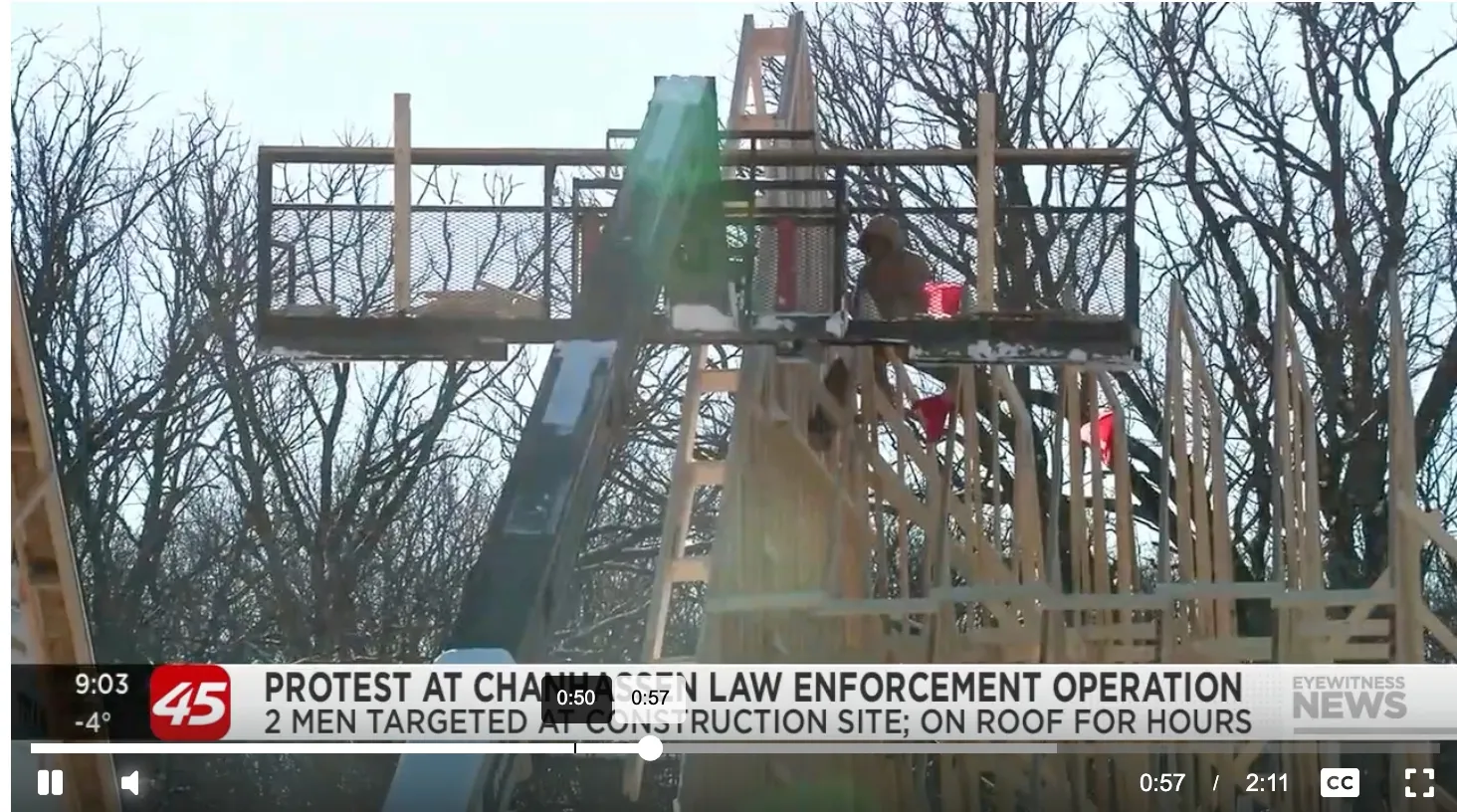
<p>The figure is noteworthy in two ways. First, the per-arrest cost (roughly thirteen thousand dollars) is large for an enforcement operation that consists primarily of street-level civil arrests rather than complex investigations. Second, it is conservative — the Tribune’s review explicitly understates by omitting categories the federal government has refused to disclose. The actual figure is higher; it is also a figure DHS has never been willing to put on a page in a press release.</p>]]></content><author><name></name></author><summary type="html"><![CDATA[Federal officials have repeatedly declined to provide a cost accounting for Operation Midway Blitz, the immigration enforcement surge that began in Illinois in early September. The Chicago Tribune assembled a conservative estimate from court filings, databases, and other public records: at least fifty-nine million dollars deployed and detained roughly forty-five hundred people through early January — covering personnel deployment, equipment, and facility costs. DHS declined to refute the figure when asked, instead pivoting to language about “convicted murderers, rapists, child abusers” and the “uncalculatable” value of “American lives saved.”]]></summary></entry><entry><title type="html">Hours on a Roof, in Subzero</title><link href="https://lightseed.net/stories/subzero-rooftop-trap/" rel="alternate" type="text/html" title="Hours on a Roof, in Subzero" /><published>2025-12-14T00:00:00+00:00</published><updated>2025-12-14T00:00:00+00:00</updated><id>https://lightseed.net/stories/subzero-rooftop-trap</id><content type="html" xml:base="https://lightseed.net/stories/subzero-rooftop-trap/"><![CDATA[<p>Masked federal agents wearing ICE vests cordoned off a Minneapolis residential construction site, refused to identify themselves or present a warrant, and trapped two construction workers on the roof for hours in subzero temperatures. A protest crowd gathered. Bystanders carried heating pads, a jacket, and food; the agents prevented them from reaching the men on the roof.</p>

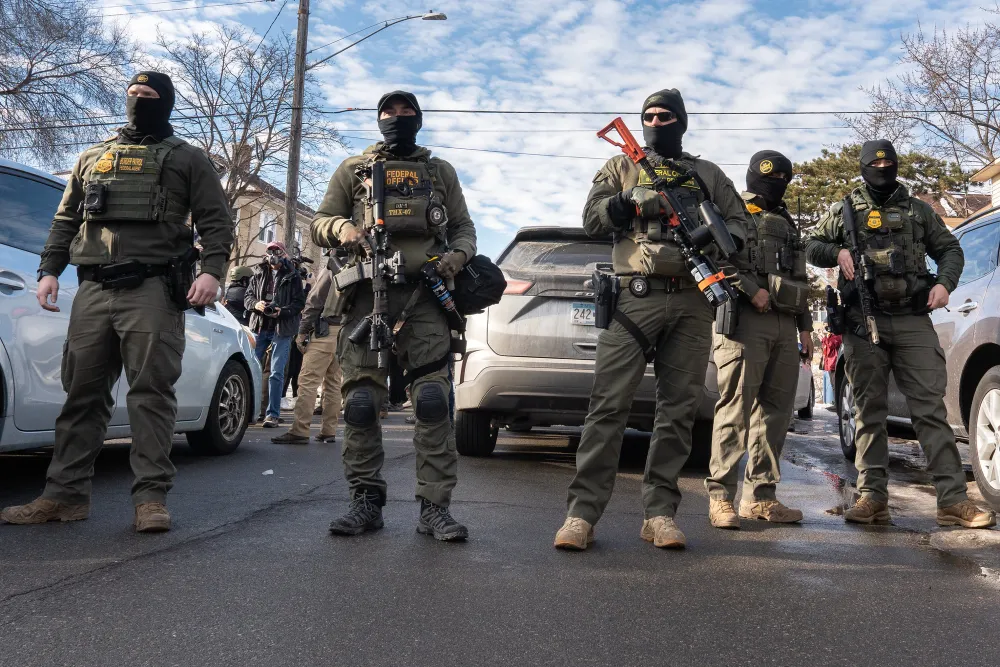
<p><img src="/assets/stories/subzero-rooftop-trap/img-38ae82ea210a11f7.jpg" alt="Photograph from the Minneapolis construction-site scene showing federal agents in tactical gear behind a cordon." /></p>

<p>A reporter at the scene counted at least thirty federal agents who took rotating shifts retreating to vehicles to stay warm — a temperature accommodation extended to the masked agents but not to the men they had cornered above. The agents eventually left; an ambulance removed one of the men from the roof.</p>

<p>The episode is at least the third documented case of federal immigration agents besieging construction workers on private residential job sites; comparable incidents had occurred in Chicago in October and outside New Orleans earlier in the year.</p>]]></content><author><name></name></author><summary type="html"><![CDATA[Masked federal agents wearing ICE vests cordoned off a Minneapolis residential construction site, refused to identify themselves or present a warrant, and trapped two construction workers on the roof for hours in subzero temperatures. A protest crowd gathered. Bystanders carried heating pads, a jacket, and food; the agents prevented them from reaching the men on the roof.]]></summary></entry><entry><title type="html">Seventy Years, A Refugee Camp, Alligator Alcatraz</title><link href="https://lightseed.net/stories/bojerski-seventy-years/" rel="alternate" type="text/html" title="Seventy Years, A Refugee Camp, Alligator Alcatraz" /><published>2025-11-17T00:00:00+00:00</published><updated>2025-11-17T00:00:00+00:00</updated><id>https://lightseed.net/stories/bojerski-seventy-years</id><content type="html" xml:base="https://lightseed.net/stories/bojerski-seventy-years/"><![CDATA[<p>Paul John Bojerski was born in 1946 to Polish parents in a German camp for displaced persons left over from the war. The family emigrated legally to the United States in 1952, when he was five. He grew up in Cleveland, never became a citizen for reasons no surviving paperwork makes clear, accumulated a deportation order at some point that authorities had elected for decades not to enforce, and lived a working life in Florida — retired optician, husband, stepfather. He had checked in regularly with Immigration and Customs Enforcement for years. In July 2025, at one of those routine check-ins at age seventy-nine, he was told that if he did not leave the country voluntarily, ICE would deport him.</p>

<p>He could not leave. He had no passport, no country of citizenship to receive him, no other state that recognized him. He returned to ICE on October 30 as instructed; he was taken into custody and sent to Alligator Alcatraz, the federal detention site improvised in the Everglades, then transferred to the Krome Detention Center near Miami. His attorney, with thirty years in immigration practice, told the Orlando Sentinel that Bojerski’s case was the most bizarre one he had handled. The decades-old removal order had not changed. What had changed is that someone, somewhere, decided that this was now the kind of order that would be acted on.</p>]]></content><author><name></name></author><summary type="html"><![CDATA[Paul John Bojerski was born in 1946 to Polish parents in a German camp for displaced persons left over from the war. The family emigrated legally to the United States in 1952, when he was five. He grew up in Cleveland, never became a citizen for reasons no surviving paperwork makes clear, accumulated a deportation order at some point that authorities had elected for decades not to enforce, and lived a working life in Florida — retired optician, husband, stepfather. He had checked in regularly with Immigration and Customs Enforcement for years. In July 2025, at one of those routine check-ins at age seventy-nine, he was told that if he did not leave the country voluntarily, ICE would deport him.]]></summary></entry><entry><title type="html">Held for the Likes</title><link href="https://lightseed.net/stories/vijandre-instagram-detention/" rel="alternate" type="text/html" title="Held for the Likes" /><published>2025-11-11T00:00:00+00:00</published><updated>2025-11-11T00:00:00+00:00</updated><id>https://lightseed.net/stories/vijandre-instagram-detention</id><content type="html" xml:base="https://lightseed.net/stories/vijandre-instagram-detention/"><![CDATA[<p>Yaa’kub Ira Vijandre, a photojournalist from Arlington, Texas, and a DACA recipient, was taken into Immigration and Customs Enforcement custody at gunpoint, where he has remained. The basis of the federal case against him, on the documents, is his pattern of social-media activity: Instagram posts and the act of “liking” content expressing support for Palestine and for U.S. citizens whom Vijandre considered wrongfully convicted.</p>

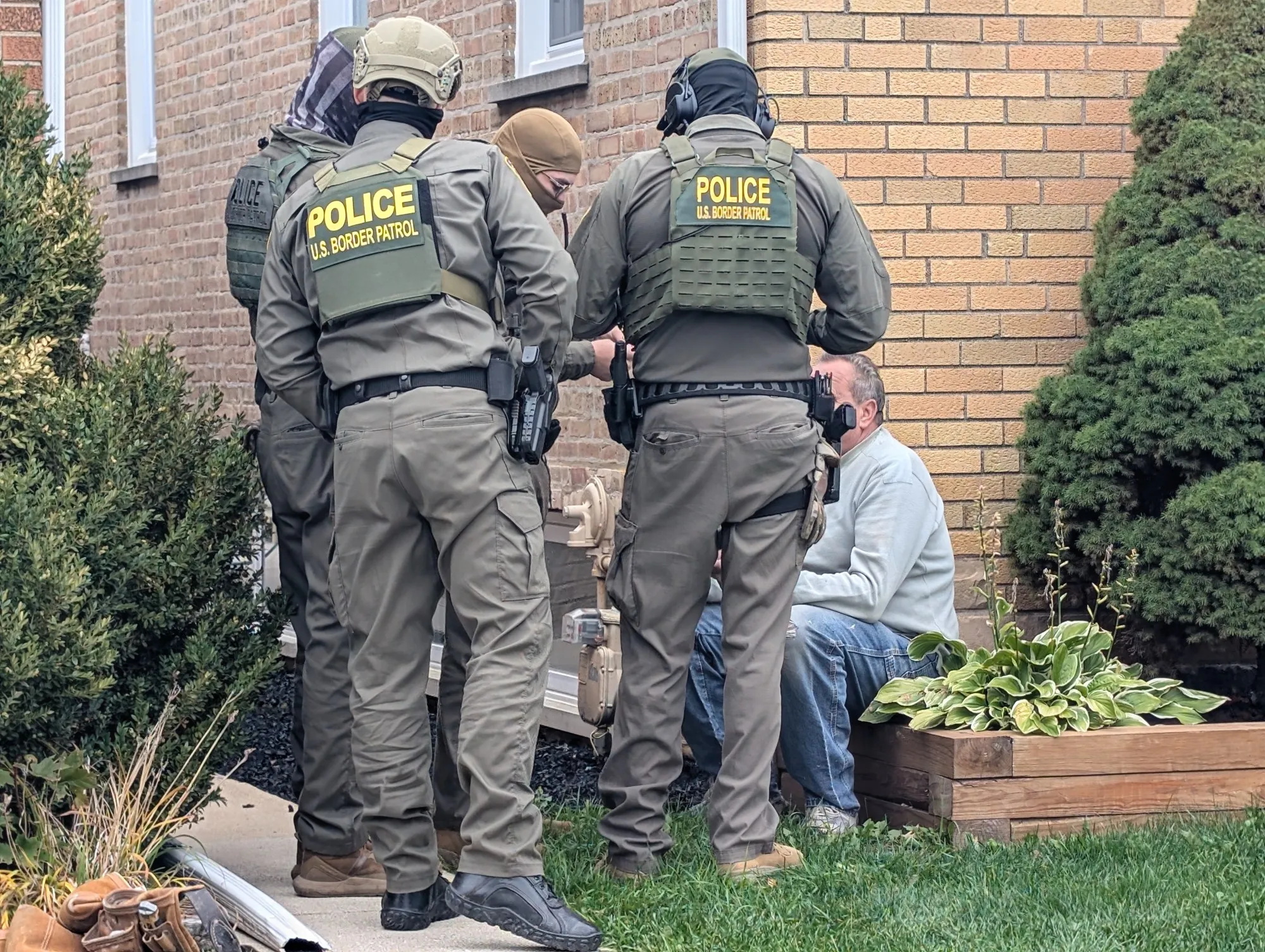
<p><img src="/assets/stories/vijandre-instagram-detention/img-26033a34fae06004.jpg" alt="Article preview: &quot;ICE Caged This Man For His Instagram Posts And Likes&quot; — Forever Wars." /></p>

<p>A new filing in Vijandre’s case asserts that he was offered the option of becoming an informant in exchange for his release and refused. The filing characterizes Vijandre as a political prisoner — held not for an act, but for the protected expression of an opinion the Department of Homeland Security disfavors.</p>]]></content><author><name></name></author><summary type="html"><![CDATA[Yaa’kub Ira Vijandre, a photojournalist from Arlington, Texas, and a DACA recipient, was taken into Immigration and Customs Enforcement custody at gunpoint, where he has remained. The basis of the federal case against him, on the documents, is his pattern of social-media activity: Instagram posts and the act of “liking” content expressing support for Palestine and for U.S. citizens whom Vijandre considered wrongfully convicted.]]></summary></entry><entry><title type="html">Deported in a Vegetative State</title><link href="https://lightseed.net/stories/gamboa-deported-vegetative/" rel="alternate" type="text/html" title="Deported in a Vegetative State" /><published>2025-11-06T00:00:00+00:00</published><updated>2025-11-06T00:00:00+00:00</updated><id>https://lightseed.net/stories/gamboa-deported-vegetative</id><content type="html" xml:base="https://lightseed.net/stories/gamboa-deported-vegetative/"><![CDATA[<p>Randall Alberto Gamboa Esquivel, fifty-two, was arrested by Immigration and Customs Enforcement in Texas in February and held first at the Webb County Detention Center, then in Port Isabel. His family spoke with him by phone daily until June, when the calls abruptly stopped. The detention center told them only that he had a “health issue.” Locating him took two months and three lawyers. By August, he was bedridden in a vegetative state. On September 3, ICE put him on an air ambulance to Costa Rica with diagnoses of encephalopathy, rhabdomyolysis, and the loss of his ability to feed himself. He died in a hospital in his hometown of Pérez Zeledón on October 26.</p>

<p>Asked about the case, DHS assistant secretary Tricia McLaughlin said the medical care Gamboa had received was better than many immigrants “have received in their entire lives,” and noted his prior immigration violations — answers that addressed neither what had happened to him nor why his family had been unable to find him for two months. The deportation of a man already in a vegetative state, by air ambulance, is the operational fact at the center of the case; the question of what happened to his body during the months his family could not reach him remains, formally, unanswered.</p>]]></content><author><name></name></author><summary type="html"><![CDATA[Randall Alberto Gamboa Esquivel, fifty-two, was arrested by Immigration and Customs Enforcement in Texas in February and held first at the Webb County Detention Center, then in Port Isabel. His family spoke with him by phone daily until June, when the calls abruptly stopped. The detention center told them only that he had a “health issue.” Locating him took two months and three lawyers. By August, he was bedridden in a vegetative state. On September 3, ICE put him on an air ambulance to Costa Rica with diagnoses of encephalopathy, rhabdomyolysis, and the loss of his ability to feed himself. He died in a hospital in his hometown of Pérez Zeledón on October 26.]]></summary></entry><entry><title type="html">The Toddler in the Backseat</title><link href="https://lightseed.net/stories/toddler-in-backseat/" rel="alternate" type="text/html" title="The Toddler in the Backseat" /><published>2025-11-05T00:00:00+00:00</published><updated>2025-11-05T00:00:00+00:00</updated><id>https://lightseed.net/stories/toddler-in-backseat</id><content type="html" xml:base="https://lightseed.net/stories/toddler-in-backseat/"><![CDATA[<p>Armed federal immigration agents in California stopped a vehicle, arrested its driver — a U.S. citizen — and prepared to drive off with the man’s car, in keeping with a routine in which a vehicle is left disabled in the road or impounded after a stop. Inside that vehicle, in a child seat, was the man’s toddler. A crowd of bystanders that had assembled at the scene refused to allow the agents to leave with the child still in the car. After the crowd’s intervention, the agents agreed to wait for the family to arrive and collect the toddler.</p>

<p>That the toddler was eventually retrieved is an outcome that depended on the crowd. The default trajectory — the procedural plan the agents began to execute before they were stopped — would have separated the child from any adult relative for at least the duration of the agents’ transport of the vehicle. The question of what protocol governs the disposition of children present at federal arrests is one the article suggests has no public answer; the operational answer, on this day, was the bystanders.</p>]]></content><author><name></name></author><summary type="html"><![CDATA[Armed federal immigration agents in California stopped a vehicle, arrested its driver — a U.S. citizen — and prepared to drive off with the man’s car, in keeping with a routine in which a vehicle is left disabled in the road or impounded after a stop. Inside that vehicle, in a child seat, was the man’s toddler. A crowd of bystanders that had assembled at the scene refused to allow the agents to leave with the child still in the car. After the crowd’s intervention, the agents agreed to wait for the family to arrive and collect the toddler.]]></summary></entry><entry><title type="html">Less Than a Minute</title><link href="https://lightseed.net/stories/villegas-gonzalez-killed/" rel="alternate" type="text/html" title="Less Than a Minute" /><published>2025-11-04T00:00:00+00:00</published><updated>2025-11-04T00:00:00+00:00</updated><id>https://lightseed.net/stories/villegas-gonzalez-killed</id><content type="html" xml:base="https://lightseed.net/stories/villegas-gonzalez-killed/"><![CDATA[<p>On September 12, two Immigration and Customs Enforcement officers stopped Silverio Villegas-Gonzalez, a thirty-eight-year-old Mexican immigrant, on a busy street in Franklin Park, Illinois, less than a minute after he had dropped off his two sons at an elementary school and a day care. Less than a minute after the stop, Villegas-Gonzalez was shot in the neck and his Subaru had crashed into a truck more than a hundred feet down the road. The Department of Homeland Security said he had hit and dragged one of the officers with his car, “seriously injuring” him; the officer had fired in self-defense. Villegas-Gonzalez was unarmed and had no criminal record beyond traffic offenses.</p>

<p>A New York Times reconstruction, drawing on multiple surveillance feeds, the officers’ body cameras, and bystander video, calls two specific elements of that account into question: the recordings do not show Villegas-Gonzalez striking either officer with the vehicle, and on his own body camera in the immediate aftermath one of the officers describes his injuries as “nothing major.” The reconstruction does not resolve every question about the encounter; it does demonstrate, frame by frame, that the official narrative — a self-defense killing of a man who had seriously injured a federal officer — is not supported by the recordings the federal officers themselves made.</p>]]></content><author><name></name></author><summary type="html"><![CDATA[On September 12, two Immigration and Customs Enforcement officers stopped Silverio Villegas-Gonzalez, a thirty-eight-year-old Mexican immigrant, on a busy street in Franklin Park, Illinois, less than a minute after he had dropped off his two sons at an elementary school and a day care. Less than a minute after the stop, Villegas-Gonzalez was shot in the neck and his Subaru had crashed into a truck more than a hundred feet down the road. The Department of Homeland Security said he had hit and dragged one of the officers with his car, “seriously injuring” him; the officer had fired in self-defense. Villegas-Gonzalez was unarmed and had no criminal record beyond traffic offenses.]]></summary></entry><entry><title type="html">Cash Bonuses for Locating Immigrants</title><link href="https://lightseed.net/stories/ice-bounty-hunter-rewards/" rel="alternate" type="text/html" title="Cash Bonuses for Locating Immigrants" /><published>2025-11-01T00:00:00+00:00</published><updated>2025-11-01T00:00:00+00:00</updated><id>https://lightseed.net/stories/ice-bounty-hunter-rewards</id><content type="html" xml:base="https://lightseed.net/stories/ice-bounty-hunter-rewards/"><![CDATA[<p>A procurement document published by U.S. Immigration and Customs Enforcement, reviewed by The Intercept, solicits private contractors to locate immigrants and report their whereabouts to the government. Contractors would receive bundles of identifying information on ten thousand people at a time, in subsequent increments of up to one million, and would be paid bonuses tied to how many of those people they successfully tracked. The document calls the structure “incentive based pricing.” Bonuses might be issued, for instance, for finding ninety percent of targets within a set timeframe, or for confirming a correct address on the first try.</p>

<p>The document closely resembles a pitch circulated in February by a group of military contractors that included former Blackwater CEO Erik Prince — a “bounty program which provides a cash reward for each illegal alien held by a state or local law enforcement officer.” The change from February to October is that the pitch is no longer a private proposal but a federal solicitation: the bounty model has moved from outside the government to inside it, written in procurement language and ready for award.</p>]]></content><author><name></name></author><summary type="html"><![CDATA[A procurement document published by U.S. Immigration and Customs Enforcement, reviewed by The Intercept, solicits private contractors to locate immigrants and report their whereabouts to the government. Contractors would receive bundles of identifying information on ten thousand people at a time, in subsequent increments of up to one million, and would be paid bonuses tied to how many of those people they successfully tracked. The document calls the structure “incentive based pricing.” Bonuses might be issued, for instance, for finding ninety percent of targets within a set timeframe, or for confirming a correct address on the first try.]]></summary></entry><entry><title type="html">Tear Gas Almost Every Day</title><link href="https://lightseed.net/stories/illinois-tear-gas-tro/" rel="alternate" type="text/html" title="Tear Gas Almost Every Day" /><published>2025-10-31T00:00:00+00:00</published><updated>2025-10-31T00:00:00+00:00</updated><id>https://lightseed.net/stories/illinois-tear-gas-tro</id><content type="html" xml:base="https://lightseed.net/stories/illinois-tear-gas-tro/"><![CDATA[<p>On October 9, U.S. District Judge Sara Ellis issued a temporary restraining order against federal agents operating under Operation Midway Blitz in Illinois, restricting their use of tear gas, pepper spray, and other “riot control weapons” against protesters and journalists, and barring them from clearing people from public spaces those people had a lawful right to occupy. A subsequent court filing alleges that the order has been violated “almost every day” since it was issued. On October 25, federal agents reportedly deployed tear gas in Chicago’s Old Irving Park as children walked to a Halloween parade at their school. From the bench, on Tuesday, Judge Ellis said: “I can only imagine how terrified they were.”</p>

<p>When the judge asked Customs and Border Protection commander Gregory Bovino to produce all use-of-force reports from agents involved in Operation Midway Blitz since September 2, Bovino said it would be impossible because of “the sheer amount.” The court ordered the reports and accompanying body-camera footage produced by the end of the week. The volume of force itself — too large to assemble — is a piece of evidence that did not exist, in that quantifiable form, before the question was put.</p>]]></content><author><name></name></author><summary type="html"><![CDATA[On October 9, U.S. District Judge Sara Ellis issued a temporary restraining order against federal agents operating under Operation Midway Blitz in Illinois, restricting their use of tear gas, pepper spray, and other “riot control weapons” against protesters and journalists, and barring them from clearing people from public spaces those people had a lawful right to occupy. A subsequent court filing alleges that the order has been violated “almost every day” since it was issued. On October 25, federal agents reportedly deployed tear gas in Chicago’s Old Irving Park as children walked to a Halloween parade at their school. From the bench, on Tuesday, Judge Ellis said: “I can only imagine how terrified they were.”]]></summary></entry><entry><title type="html">Operation in the Most Conservative Neighborhood</title><link href="https://lightseed.net/stories/edison-park-cbp-grab/" rel="alternate" type="text/html" title="Operation in the Most Conservative Neighborhood" /><published>2025-10-31T00:00:00+00:00</published><updated>2025-10-31T00:00:00+00:00</updated><id>https://lightseed.net/stories/edison-park-cbp-grab</id><content type="html" xml:base="https://lightseed.net/stories/edison-park-cbp-grab/"><![CDATA[<p>On an October 2025 afternoon, Border Patrol agents removed people working in the front yard of a home on Oconto Avenue in Edison Park — the most conservative neighborhood in Chicago, by the local accounting — and drove them in convoy to a parking lot behind an office building in Niles, where they were transferred to a prisoner van. A CBP helicopter circled the convoy. The chief was on scene but stayed back. The neighborhood gathered as the operation continued.</p>

<p><img src="/assets/stories/edison-park-cbp-grab/img-e4a9b58a11aba83d.jpg" alt="Photograph from the Edison Park scene: federal agents in tactical gear stand near a residential street, with neighbors visible in the background." /></p>

<p>“You’re in the most conservative neighborhood in the city and nobody wants you here,” a neighbor told the agents. Whistles followed the convoy as it moved. Filming continued from sidewalks and porches. CBP, in turn, made a show of pointing cameras at protesters and at press IDs.</p>

<p>The processing happened in a parking lot west of Caldwell, south of Jarvis. An agent in a tattered American-flag gaiter told a photographer they were done for the day. A straw hat and a neon vest sat on the dashboard of the prisoner van, headed toward the Broadview detention staging area.</p>]]></content><author><name></name></author><summary type="html"><![CDATA[On an October 2025 afternoon, Border Patrol agents removed people working in the front yard of a home on Oconto Avenue in Edison Park — the most conservative neighborhood in Chicago, by the local accounting — and drove them in convoy to a parking lot behind an office building in Niles, where they were transferred to a prisoner van. A CBP helicopter circled the convoy. The chief was on scene but stayed back. The neighborhood gathered as the operation continued.]]></summary></entry><entry><title type="html">Fifty-Plus Cases That Fell Apart</title><link href="https://lightseed.net/stories/us-citizens-grabbed/" rel="alternate" type="text/html" title="Fifty-Plus Cases That Fell Apart" /><published>2025-10-18T00:00:00+00:00</published><updated>2025-10-18T00:00:00+00:00</updated><id>https://lightseed.net/stories/us-citizens-grabbed</id><content type="html" xml:base="https://lightseed.net/stories/us-citizens-grabbed/"><![CDATA[<p>A ProPublica investigation by reporter Nicole Foy tracked, by sourcing from social media, court records, and local press in Spanish and English, more than fifty cases of US citizens detained by federal immigration agents on charges that subsequently collapsed in court or were never filed at all. The pattern crossed demographics: senior citizens tackled, pregnant women handcuffed, children detained, a veteran pulled from his car on the way to work.</p>

<p><img src="/assets/stories/us-citizens-grabbed/img-2325c37c131e4c47.jpg" alt="Stat graphic: white text on a black background reading &quot;50+ — Immigration agents have the authority to detain whom they reasonably suspect are in the country&quot; — followed by additional text not fully visible in the preview." /></p>

<p>The mechanism for entry into custody was often not a citizenship-status question at all but an alleged assault on or interference with an officer. The catalogue includes the case of Andrea Velez, an LA woman accused of an assault that did not appear on the available video, whose case was dismissed by a federal judge. Other charges in the sample included causing an injury to “the thumb of an ATF Special Agent,” using a trash can to block CBP cars, and “resisting arrest” of unspecified scope.</p>

<p>The investigation’s methodology was, by the reporter’s own description, ad hoc — TikTok, Instagram, a personal spreadsheet — necessitated by the absence of any official agency tracking of US-citizen-in-custody incidents. The number 50+ is, on the same logic, a floor rather than a count.</p>]]></content><author><name></name></author><summary type="html"><![CDATA[A ProPublica investigation by reporter Nicole Foy tracked, by sourcing from social media, court records, and local press in Spanish and English, more than fifty cases of US citizens detained by federal immigration agents on charges that subsequently collapsed in court or were never filed at all. The pattern crossed demographics: senior citizens tackled, pregnant women handcuffed, children detained, a veteran pulled from his car on the way to work.]]></summary></entry><entry><title type="html">What the Body Cam Said</title><link href="https://lightseed.net/stories/marimar-martinez-shooting/" rel="alternate" type="text/html" title="What the Body Cam Said" /><published>2025-10-18T00:00:00+00:00</published><updated>2025-10-18T00:00:00+00:00</updated><id>https://lightseed.net/stories/marimar-martinez-shooting</id><content type="html" xml:base="https://lightseed.net/stories/marimar-martinez-shooting/"><![CDATA[<p>Federal agents shot Marimar Martinez, a US citizen in Chicago, multiple times in October 2025. In the immediate aftermath, the Department of Homeland Security and Secretary Kristi Noem described the shooting as a response to Martinez “ramming” agents’ vehicles in a “boxed-in” group of ten cars, brandishing a gun, and “forcing” the agent to open fire. Martinez, the official account said, “drove herself to the hospital.”</p>

<p><img src="/assets/stories/marimar-martinez-shooting/img-b9cd7a2dba554b2f.jpg" alt="Article preview: &quot;Trump's Secret Police Shot a Citizen. Then Damning New Info Emerged.&quot; — The New Republic." /></p>

<p>Each element of that account began to fail under examination. The federal charging document discussed two cars, not ten, made no reference to a gun, and noted that an ambulance — not Martinez — transported her to the hospital. Body camera footage, according to her counsel, undermines the claim that her vehicle was driven toward the agents and captures one of the officers saying “do something, bitch” immediately before opening fire.</p>

<p>Senator Chris Murphy responded with an unusual letter to Secretary Noem, demanding a public correction of the administration’s false statements about the shooting. The intervention is unusual because the underlying conditions are unusual: oversight mechanisms typically applied to federal agents have so atrophied that an individual member of Congress writing a public correction letter is something close to an outer accountability boundary.</p>]]></content><author><name></name></author><summary type="html"><![CDATA[Federal agents shot Marimar Martinez, a US citizen in Chicago, multiple times in October 2025. In the immediate aftermath, the Department of Homeland Security and Secretary Kristi Noem described the shooting as a response to Martinez “ramming” agents’ vehicles in a “boxed-in” group of ten cars, brandishing a gun, and “forcing” the agent to open fire. Martinez, the official account said, “drove herself to the hospital.”]]></summary></entry><entry><title type="html">What the Cold War Did to Passports</title><link href="https://lightseed.net/stories/kraut-rubio-citizen-speech/" rel="alternate" type="text/html" title="What the Cold War Did to Passports" /><published>2025-09-13T00:00:00+00:00</published><updated>2025-09-13T00:00:00+00:00</updated><id>https://lightseed.net/stories/kraut-rubio-citizen-speech</id><content type="html" xml:base="https://lightseed.net/stories/kraut-rubio-citizen-speech/"><![CDATA[<p>The Intercept reported in September 2025 that Secretary of State Marco Rubio, who as senator and as secretary had already sought to punish noncitizens for protected speech, was poised under newly proposed legislation to extend that authority to U.S. citizens — most concretely through revocation of passports as a sanction for political activity. Historian Julia Rose Kraut, whose book <em>Threat of Dissent</em> documents the federal record of speech-based passport and citizenship sanctions across the twentieth century, posted a brief reminder to the public conversation: it was tried in the Cold War; the Supreme Court intervened.</p>

<p>The Court’s 1958 ruling in <em>Kent v. Dulles</em> held that the right of a U.S. citizen to travel — including the State Department’s discretion in denying passports on the basis of political beliefs — could not be conditioned on speech without specific statutory authority that did not, in that case, exist. The legislation the Intercept describes would be the kind of authority the Court found absent. Kraut does not predict what the courts will do; she points at the historical fact that the question has been answered before.</p>]]></content><author><name></name></author><summary type="html"><![CDATA[The Intercept reported in September 2025 that Secretary of State Marco Rubio, who as senator and as secretary had already sought to punish noncitizens for protected speech, was poised under newly proposed legislation to extend that authority to U.S. citizens — most concretely through revocation of passports as a sanction for political activity. Historian Julia Rose Kraut, whose book Threat of Dissent documents the federal record of speech-based passport and citizenship sanctions across the twentieth century, posted a brief reminder to the public conversation: it was tried in the Cold War; the Supreme Court intervened.]]></summary></entry></feed>