STORIES OF 47

Theme: predatory capital — full compilation

Where private wealth is built on the apparatus — shareholders, executive compensation, defense contractors, family business interests.

View as list →


Cash Bonuses for Locating Immigrants

Nov 1, 2025 · The Intercept

An ICE procurement document reviewed by The Intercept solicits private contractors to locate immigrants in batches of ten thousand at a time, with monetary bonuses paid based on how many targets are successfully tracked down — the contractor model resembles a plan circulated earlier in the year by former Blackwater CEO Erik Prince.

A procurement document published by U.S. Immigration and Customs Enforcement, reviewed by The Intercept, solicits private contractors to locate immigrants and report their whereabouts to the government. Contractors would receive bundles of identifying information on ten thousand people at a time, in subsequent increments of up to one million, and would be paid bonuses tied to how many of those people they successfully tracked. The document calls the structure “incentive based pricing.” Bonuses might be issued, for instance, for finding ninety percent of targets within a set timeframe, or for confirming a correct address on the first try.

The document closely resembles a pitch circulated in February by a group of military contractors that included former Blackwater CEO Erik Prince — a “bounty program which provides a cash reward for each illegal alien held by a state or local law enforcement officer.” The change from February to October is that the pitch is no longer a private proposal but a federal solicitation: the bounty model has moved from outside the government to inside it, written in procurement language and ready for award.


Fifty-Nine Million, Conservatively

Jan 4, 2026 · Chicago Tribune, Dan Vock

A Chicago Tribune review of court filings, databases, and public records puts the federal cost of Operation Midway Blitz, the immigration enforcement surge in Illinois, at at least fifty-nine million dollars over four months — a back-of-the-envelope figure DHS declined to confirm or contest.

Federal officials have repeatedly declined to provide a cost accounting for Operation Midway Blitz, the immigration enforcement surge that began in Illinois in early September. The Chicago Tribune assembled a conservative estimate from court filings, databases, and other public records: at least fifty-nine million dollars deployed and detained roughly forty-five hundred people through early January — covering personnel deployment, equipment, and facility costs. DHS declined to refute the figure when asked, instead pivoting to language about “convicted murderers, rapists, child abusers” and the “uncalculatable” value of “American lives saved.”

The figure is noteworthy in two ways. First, the per-arrest cost (roughly thirteen thousand dollars) is large for an enforcement operation that consists primarily of street-level civil arrests rather than complex investigations. Second, it is conservative — the Tribune’s review explicitly understates by omitting categories the federal government has refused to disclose. The actual figure is higher; it is also a figure DHS has never been willing to put on a page in a press release.


One Hundred and Fifty Leases

Feb 10, 2026 · WIRED, Leah Feiger

WIRED reviewed federal records showing that Immigration and Customs Enforcement has secretly negotiated more than 150 new office leases and expansions across nearly every U.S. state — many near schools, medical offices, and places of worship — with the General Services Administration explicitly asked to bypass usual procurement procedures and conceal listings under 'national security' pretext.

Federal records obtained by WIRED document a months-long, deliberately quiet expansion of Immigration and Customs Enforcement’s physical footprint: more than one hundred and fifty leases and office expansions, in nearly every state, frequently sited near elementary schools, child-care providers, medical offices, and other places the agency itself classifies as sensitive. The General Services Administration, which manages federal real estate, was asked in writing by DHS to disregard normal lease procurement procedures and to conceal listings on grounds of “national security.” A GSA spokesperson, asked, said only that GSA was “following all lease procurement procedures in accordance with all applicable laws and regulations.”

The expansion is the physical correlate of the agency’s funding surge under the One Big Beautiful Bill Act, which directed nearly eighty billion dollars to ICE. The agency has more than doubled in size since January 2025; the offices are where the new agents will work. Reporting on the build-out is not, in itself, a scandal — every federal agency leases office space — but the procurement choices reveal an intent: place the offices where they can be reached quickly, and place them quietly enough that the cities involved cannot organize against them in advance.


The Customer in Question

Feb 15, 2026 · ProPublica

CoreCivic's CEO described Immigration and Customs Enforcement as a 'customer' on a 2025 earnings call; investors on the same calls expressed frustration that the agency's record detention numbers were not yet high enough. ICE revenues for the contractor more than doubled that year.

On a CoreCivic earnings call in early 2026, CEO Patrick Swindle described Immigration and Customs Enforcement as a “customer” with whom the company maintained “constant dialogue” to evaluate “how we can participate in that” mission. CoreCivic and GEO Group, the two largest private operators of immigration detention facilities in the United States, had reactivated idle capacity in advance of the second Trump administration’s enforcement push. The Dilley, Texas family detention center — where letters from imprisoned children reached ProPublica reporters — is among those reactivated facilities.

Article preview: "The Kids Trump Sent to ICE's Dilley Detention Center" — ProPublica.

CoreCivic’s executive compensation is structured to track company earnings. ICE revenues for the company more than doubled in 2025. Investors on the same earnings calls — Raj Sharma of Texas Bank, Matthew Arbner of Jones Trading, Greg Gibas of Northland Securities, Ben Briggs of StoneX Financial, M. Marin of Zacks, Bill Sutherland of Benchmark, Joe Gomes of Noble Capital — were on record expressing frustration that record detention numbers had not climbed higher.

The frustration is the substance. There is, on this analytic frame, no scenario in which a facility designed to hold immigrants is full enough.


The Procurement Officer's Former Employer

Feb 17, 2026 · BlueSky, Aaron Reichlin-Melnick

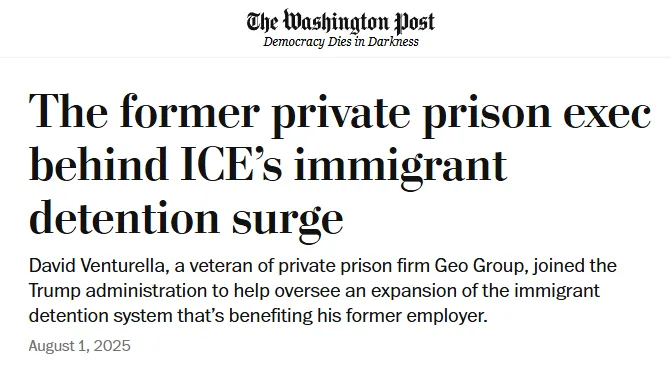
The federal official directing Immigration and Customs Enforcement's detention procurement is a former GEO Group executive who, by ethics waiver, was permitted to award contracts to his prior employer — a company poised to receive tens of billions of dollars over four years through detention contracts often awarded without competitive bids.

The federal official directing Immigration and Customs Enforcement’s detention procurement is David Venturella, a former executive of GEO Group, where he ran the company’s immigration detention portfolio. The Department of Homeland Security granted him a written ethics waiver permitting him to award contracts to his prior employer in his new role.

Screenshot from a Washington Post profile of David Venturella with the headline "The former private prison exec behind ICE's immigrant detention surge."

The waiver has functioned. GEO’s principal access to ICE money runs through a complex Navy procurement system used to disburse most of the $45 billion the Navy distributed last year, allowing ICE to direct contracts to GEO without competitive bids. GEO’s competitors — other private detention operators eyeing the same expanding market — have not received comparable channels of access.

By industry estimate, GEO Group is positioned to receive tens of billions of federal dollars over the next four years for detaining immigrants. The procurement officer who directs those contracts came directly from the company that receives them.


The Pool

Mar 7, 2026 · Mother Jones

An Associated Press investigation, drawn from 911 calls and detainee accounts, reports that staff at the nation's largest ICE detention facility — Camp East Montana on Fort Bliss in Texas — placed bets on which detainee would next die by suicide; Camp East Montana sits on the site of a World War II Japanese American internment camp.

According to Associated Press reporting based on 911 call logs and detainee accounts, staff at Camp East Montana — the nation’s largest Immigration and Customs Enforcement detention facility, holding around three thousand people in tents on Fort Bliss in El Paso, Texas — operated a betting pool on which detainee would next die by suicide. Owen Ramsingh, a legal permanent resident held there for several weeks, told the AP that he overheard a guard say he had paid five hundred dollars into the pot, with payouts going to the staff member with the most accurate predictions. DHS told the AP that Ramsingh, who was brought to the United States from the Netherlands at age five, was lying. In January, the facility called 911 for Geraldo Lunas Campos, a fifty-five-year-old Cuban man; DHS reported it as an attempted suicide, but a medical examiner ruled the death a homicide. That same month, a thirty-six-year-old Nicaraguan man at the facility died by suicide.

The site itself is significant: Camp East Montana stands where Fort Bliss housed Japanese Americans during World War II. The AP’s review documents one hundred and thirty 911 calls in the first roughly five months of operation, including at least six additional self-harm incidents serious enough to require emergency response. The betting pool, if it operated as Ramsingh described, was therefore betting on a frequent enough event that wagering on its next instance was a structurally coherent activity for guards to organize.


The Sons' New Drone Company

Mar 9, 2026 · The Wall Street Journal

Eric Trump and Donald Trump Jr. are backers of a new drone company explicitly targeting Pentagon contracts; the company would profit from defense procurement decisions made by the administration of which their father is the head.

Eric Trump and Donald Trump Jr. are backers of a new drone company whose business plan, on the public record, is winning Pentagon procurement contracts. Their father is the sitting president of the United States, who controls the executive branch within which the Department of Defense awards those contracts.

Article preview: "Trump Sons Back New Drone Company Targeting Pentagon Sales" — The Wall Street Journal.

The structural conflict needs no decoding: a defense vendor whose senior backers are children of the commander-in-chief, competing for contracts let by his administration. The arrangement is what the federal anti-emoluments architecture, written across the Constitution and various statutes, was designed to prevent — though enforcement of those provisions has, since 2017, depended primarily on shame.


Inside Dilley

Mar 26, 2026 · Mother Jones

Sworn declarations from detained children and parents at the Dilley Immigration Processing Center — the nation's only family detention facility, run by CoreCivic and reopened in 2025 — describe vomit-inducing food, denied medical care, intimidating guards, and a four-year-old who developed a black eye after hitting his head, his potential concussion left untreated.

The Dilley Immigration Processing Center in south Texas — closed by the Biden administration in 2024, reopened in 2025 as part of a forty-five-billion-dollar detention expansion — is the only ICE family detention facility in the country. It is run for ICE by the private prison corporation CoreCivic. Journalists are not permitted inside; congressional oversight visits, until earlier this month, required a week’s advance application. The body of evidence about life inside is therefore almost entirely indirect: sworn declarations submitted by detained children and parents to legal aid groups, some of them filed as exhibits in litigation, others collected by RAICES simply for the record.

Those declarations describe food that has caused a woman to vomit blood, denied or delayed medical and mental-health care, sleeping conditions that resist sleep, intimidation by guards, and a four-year-old who hit his head, developed a black eye, and was not assessed for concussion. DHS and CoreCivic have published websites refuting the claims. The methodological difficulty of testing those refutations — when journalists are barred and detainees’ communications are constrained — is itself part of the story. The closure of the channels through which evidence would normally be examined is what permits the official denials to operate as the only public record from inside the facility.