STORIES OF 47

Theme: official narrative — full compilation

The gap between official accounts and what evidence shows — propaganda, denial, and the deployment and unraveling of state-issued fictions.

View as list →


What the Cold War Did to Passports

Sep 13, 2025 · BlueSky, Julia Rose Kraut

Historian Julia Rose Kraut, author of 'Threat of Dissent,' surfaced the Kent v. Dulles precedent on Bluesky in response to an Intercept report that Secretary of State Marco Rubio — who has already sought to punish immigrants for their speech — would have new legislative authority to extend that punishment to U.S. citizens; in 1958 the Supreme Court held that the right to travel cannot be conditioned on a citizen's political speech.

The Intercept reported in September 2025 that Secretary of State Marco Rubio, who as senator and as secretary had already sought to punish noncitizens for protected speech, was poised under newly proposed legislation to extend that authority to U.S. citizens — most concretely through revocation of passports as a sanction for political activity. Historian Julia Rose Kraut, whose book Threat of Dissent documents the federal record of speech-based passport and citizenship sanctions across the twentieth century, posted a brief reminder to the public conversation: it was tried in the Cold War; the Supreme Court intervened.

The Court’s 1958 ruling in Kent v. Dulles held that the right of a U.S. citizen to travel — including the State Department’s discretion in denying passports on the basis of political beliefs — could not be conditioned on speech without specific statutory authority that did not, in that case, exist. The legislation the Intercept describes would be the kind of authority the Court found absent. Kraut does not predict what the courts will do; she points at the historical fact that the question has been answered before.
What the Body Cam Said

Oct 18, 2025 · The New Republic, Greg Sargent

Federal agents shot Marimar Martinez, a US citizen in Chicago, multiple times; the Department of Homeland Security's account claimed she menaced agents with a gun and her car, but charging documents and body camera footage have since contradicted nearly every element.

Federal agents shot Marimar Martinez, a US citizen in Chicago, multiple times in October 2025. In the immediate aftermath, the Department of Homeland Security and Secretary Kristi Noem described the shooting as a response to Martinez “ramming” agents’ vehicles in a “boxed-in” group of ten cars, brandishing a gun, and “forcing” the agent to open fire. Martinez, the official account said, “drove herself to the hospital.”

Article preview: "Trump's Secret Police Shot a Citizen. Then Damning New Info Emerged." — The New Republic.

Each element of that account began to fail under examination. The federal charging document discussed two cars, not ten, made no reference to a gun, and noted that an ambulance — not Martinez — transported her to the hospital. Body camera footage, according to her counsel, undermines the claim that her vehicle was driven toward the agents and captures one of the officers saying “do something, bitch” immediately before opening fire.

Senator Chris Murphy responded with an unusual letter to Secretary Noem, demanding a public correction of the administration’s false statements about the shooting. The intervention is unusual because the underlying conditions are unusual: oversight mechanisms typically applied to federal agents have so atrophied that an individual member of Congress writing a public correction letter is something close to an outer accountability boundary.


Less Than a Minute

Nov 4, 2025 · The New York Times

A New York Times reconstruction of the September 12 Chicago-area shooting of Silverio Villegas-Gonzalez — drawing on surveillance footage, body-camera video, and bystander recordings — contradicts the DHS account: the videos do not show Villegas-Gonzalez striking either officer with his car, and one of the officers describes his own injuries on camera as 'nothing major.'

On September 12, two Immigration and Customs Enforcement officers stopped Silverio Villegas-Gonzalez, a thirty-eight-year-old Mexican immigrant, on a busy street in Franklin Park, Illinois, less than a minute after he had dropped off his two sons at an elementary school and a day care. Less than a minute after the stop, Villegas-Gonzalez was shot in the neck and his Subaru had crashed into a truck more than a hundred feet down the road. The Department of Homeland Security said he had hit and dragged one of the officers with his car, “seriously injuring” him; the officer had fired in self-defense. Villegas-Gonzalez was unarmed and had no criminal record beyond traffic offenses.

A New York Times reconstruction, drawing on multiple surveillance feeds, the officers’ body cameras, and bystander video, calls two specific elements of that account into question: the recordings do not show Villegas-Gonzalez striking either officer with the vehicle, and on his own body camera in the immediate aftermath one of the officers describes his injuries as “nothing major.” The reconstruction does not resolve every question about the encounter; it does demonstrate, frame by frame, that the official narrative — a self-defense killing of a man who had seriously injured a federal officer — is not supported by the recordings the federal officers themselves made.


Fifty-Nine Million, Conservatively

Jan 4, 2026 · Chicago Tribune, Dan Vock

A Chicago Tribune review of court filings, databases, and public records puts the federal cost of Operation Midway Blitz, the immigration enforcement surge in Illinois, at at least fifty-nine million dollars over four months — a back-of-the-envelope figure DHS declined to confirm or contest.

Federal officials have repeatedly declined to provide a cost accounting for Operation Midway Blitz, the immigration enforcement surge that began in Illinois in early September. The Chicago Tribune assembled a conservative estimate from court filings, databases, and other public records: at least fifty-nine million dollars deployed and detained roughly forty-five hundred people through early January — covering personnel deployment, equipment, and facility costs. DHS declined to refute the figure when asked, instead pivoting to language about “convicted murderers, rapists, child abusers” and the “uncalculatable” value of “American lives saved.”

The figure is noteworthy in two ways. First, the per-arrest cost (roughly thirteen thousand dollars) is large for an enforcement operation that consists primarily of street-level civil arrests rather than complex investigations. Second, it is conservative — the Tribune’s review explicitly understates by omitting categories the federal government has refused to disclose. The actual figure is higher; it is also a figure DHS has never been willing to put on a page in a press release.


The Doxxing That Hasn't Happened

Jan 30, 2026 · How To Read This Chart (Philip Bump), Philip Bump

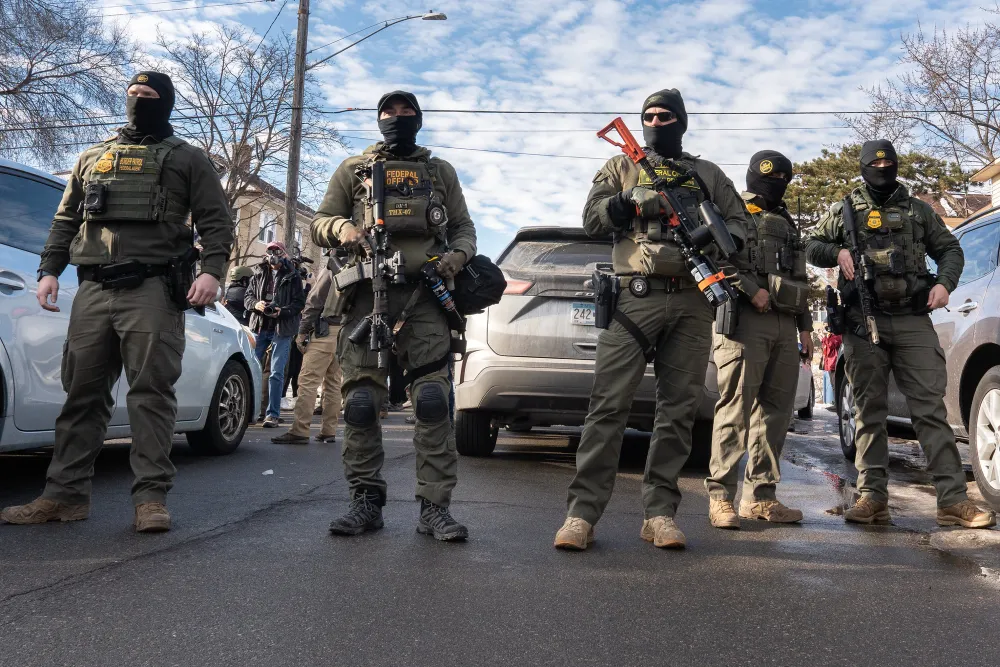
The Department of Homeland Security has cited doxxing of ICE agents and rising assaults as the public rationale for permitting agents to operate while masked; according to DHS's own press releases, no ICE agent has been doxxed or assaulted in connection with this rationale since the start of the second Trump administration.

Since early 2025, the Department of Homeland Security has cited two threats — doxxing of officers and a spike in physical assaults — as the public rationale for permitting Immigration and Customs Enforcement agents to operate while masked. Masking conceals identity and accountability. Conventional law-enforcement practice in the United States is the opposite, on the principle that the public grants police the right to detain and use force in exchange for visible, identifiable accountability.

Article preview: "ICE's excuse for wearing masks has never actually manifested."

Examination of DHS’s own press releases over the period in question turned up no agent who had been doxxed in connection with the cited rationale, and no incident of doxxing-led assault. The department’s stated reason for masking has not, by its own public record, occurred. The masking continues.


The Sheriff Who Spoke Up

Feb 3, 2026 · Bangor Daily News, Phil Lewis

A day after Cumberland County, Maine sheriff Kevin Joyce publicly criticized ICE for arresting one of his corrections officers, ICE served the county with a subpoena demanding employment data on every person who had worked at the jail since January 2025; the agency separately ended its long-standing detention contract with the county.

Kevin Joyce, the sheriff of Cumberland County, Maine, held a press conference during ICE’s January enforcement surge in the state to criticize the agency’s tactics. The day before, federal agents had arrested one of his own corrections officers — Emanuel Ludovic Mbuangi Landila, an Angolan immigrant whom Joyce described as “squeaky clean” and who had passed multiple background checks and held a valid work permit. The day after the press conference, ICE served the county with a subpoena demanding employment data on every person who had worked at the Cumberland County jail since January 2025. The county complied. ICE separately began moving detainees out of the jail, which had housed federal detainees under a long-standing contract; an agency spokesperson said it could no longer partner with a jail that employed an “illegal alien.”

Joyce had spoken publicly. The subpoena and the contract termination followed within hours and a day, respectively. The Bangor Daily News notes that the formal reason for the subpoena has not been articulated by the agency. The sequence — a federal agency, criticized by a local official, demands employment records on that official’s entire workforce — reads as either coincidence or signal; the article does not name it as one or the other, but Maine sheriffs are not numerous, and other Maine sheriffs may now have opinions about whether to hold press conferences.


Seventy-Three Percent

Feb 18, 2026 · The Bulwark

Of people booked into Immigration and Customs Enforcement custody since the start of the second Trump administration's enforcement push, seventy-three percent had no criminal conviction of any kind; eight percent had a conviction for a violent or property offense.

Of the people booked into Immigration and Customs Enforcement custody between October 1, 2025 and the date of the available data, seventy-three percent had no criminal conviction of any kind. Eight percent had a conviction for a violent or property offense. The remaining nineteen percent had been convicted of something — most commonly an immigration-related offense, including the act of unlawful presence itself.

Article preview: "Tricia McLaughlin's Top Five Lies" — The Bulwark.

The figure cannot be reconciled with the administration’s repeated framing of mass enforcement as targeted toward “the worst of the worst” or “criminal illegal aliens.” The framing requires that the people in custody be the people the framing describes; the data show, to a near-three-quarters majority, that they are not.


When the Cameras Came Out

Feb 21, 2026 · The Guardian

Federal prosecutions of protesters and others accused of 'assaulting' or 'impeding' federal officers have repeatedly collapsed when courtroom evidence — particularly video — contradicted the officers' sworn statements.

Department of Justice prosecutions of protesters, immigrants, and bystanders accused of “assaulting” or “impeding” federal officers during immigration operations have collapsed in court at a rate that has begun to alarm even the prosecutors. Cases have been dismissed or ended in not-guilty verdicts after video evidence contradicted the officers’ sworn accounts. In one Minnesota case, a protester accused of assaulting an ICE officer was cleared when footage showed no assault had occurred. In a Los Angeles case, charges against a protester accused of striking an ICE officer with a hat were dropped after a federal judge ruled the government had acted in “bad faith.”

The pattern documents a specific operational dependency. The government’s enforcement strategy has relied on uncorroborated officer statements as the basis for federal charges. Where such statements have met contemporaneous video, the charges have not survived.

The defendants whose cases were dismissed are not made whole by the dismissal. The arrests, the bookings, the legal fees, the time in detention or under bond conditions — these stand whether or not the officer’s account is ultimately credited.


When the Body Cameras Caught the Chase

Mar 26, 2026 · Unraveled Press, Steve Held

Body camera footage from an October 2025 Chicago incident contradicts the Department of Homeland Security's account: Border Patrol agents continued a high-speed pursuit against direct supervisor orders to end it, blew a tire, crashed, and then deployed tear gas in the surrounding neighborhood.

Body camera footage of an October 2025 incident in Chicago’s East Side neighborhood shows three named Border Patrol agents continuing an eighteen-minute high-speed vehicle pursuit after their supervisor ordered them to call it off. The chase ended when the agents’ own vehicle blew a tire and crashed. The agents then deployed tear gas in the surrounding residential neighborhood.

The Department of Homeland Security’s official account had described the crash as the result of agents intentionally striking the fleeing vehicle to stop it. The footage reveals neither the deliberate strike nor the intentional choice, but instead a tire failure following a chase that should have ended several minutes earlier.

Three agents are named in the reviews. Whether the gap between the official account and the visual record will produce any consequence for those agents is, as of this writing, unresolved.


The First Bumbling Raid

Mar 28, 2026 · The Watch (Radley Balko), Radley Balko

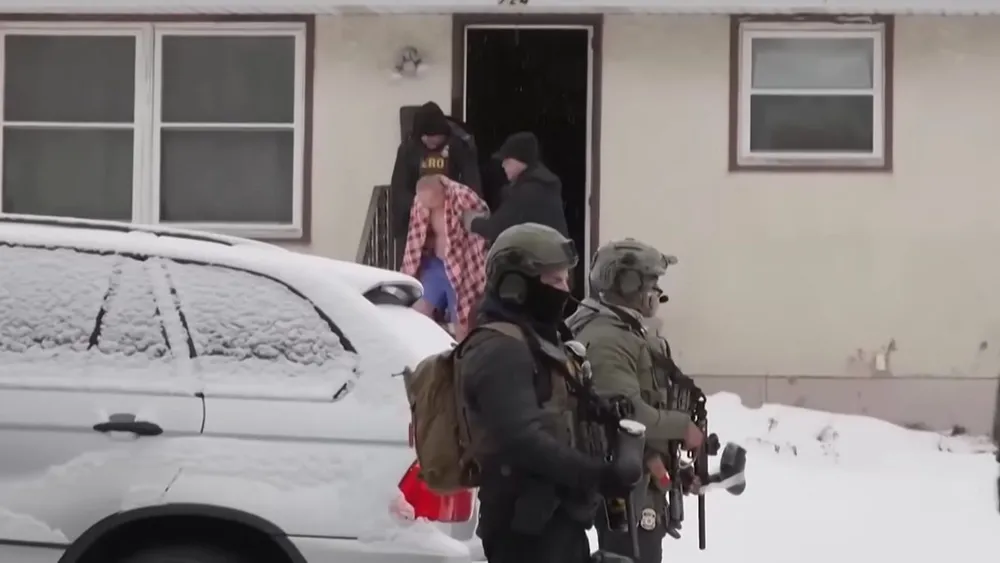
Investigative journalist Radley Balko launched an ongoing series cataloguing the false official statements that the Department of Homeland Security has issued after specific acts of abuse or violence by ICE and Border Patrol officers in the field; the first installment examines the illegal raid on ChongLy Scott Thao and his family.

Investigative journalist Radley Balko launched an ongoing series cataloguing the false official statements that the Department of Homeland Security has issued after specific acts of abuse or violence by Immigration and Customs Enforcement and Border Patrol officers in the field. The first installment examines the illegal raid on ChongLy Scott Thao and his family — a raid the agency described publicly in terms that contradicted its own paperwork.

Substack article preview titled "You Can't Hide Your Lying ICE."

The series itself is the substance: any single instance of an agency lying about a botched operation can be dismissed as anomaly; a methodical accumulation of cases, each documented from the public record, is a different kind of evidence. The cataloguing converts what looks like noise into pattern.