Theme: deportation machinery — full compilation
The apparatus of removal — its scale, its logic, its asymmetric efficiency.
View as list →
Operation in the Most Conservative Neighborhood
Oct 31, 2025 ·
BlueSky, Peter Nickeas
A Border Patrol operation seized people working in the front yard of a home in Edison Park, Chicago, transferred them in a parking lot in a neighboring suburb to a prisoner van, and was met by neighbors blowing whistles and shouting at the agents.
On an October 2025 afternoon, Border Patrol agents removed people working in the front yard of a home on Oconto Avenue in Edison Park — the most conservative neighborhood in Chicago, by the local accounting — and drove them in convoy to a parking lot behind an office building in Niles, where they were transferred to a prisoner van. A CBP helicopter circled the convoy. The chief was on scene but stayed back. The neighborhood gathered as the operation continued.

“You’re in the most conservative neighborhood in the city and nobody wants you here,” a neighbor told the agents. Whistles followed the convoy as it moved. Filming continued from sidewalks and porches. CBP, in turn, made a show of pointing cameras at protesters and at press IDs.
The processing happened in a parking lot west of Caldwell, south of Jarvis. An agent in a tattered American-flag gaiter told a photographer they were done for the day. A straw hat and a neon vest sat on the dashboard of the prisoner van, headed toward the Broadview detention staging area.
Read original →
Cash Bonuses for Locating Immigrants
Nov 1, 2025 ·
The Intercept
An ICE procurement document reviewed by The Intercept solicits private contractors to locate immigrants in batches of ten thousand at a time, with monetary bonuses paid based on how many targets are successfully tracked down — the contractor model resembles a plan circulated earlier in the year by former Blackwater CEO Erik Prince.
A procurement document published by U.S. Immigration and Customs Enforcement, reviewed by The Intercept, solicits private contractors to locate immigrants and report their whereabouts to the government. Contractors would receive bundles of identifying information on ten thousand people at a time, in subsequent increments of up to one million, and would be paid bonuses tied to how many of those people they successfully tracked. The document calls the structure “incentive based pricing.” Bonuses might be issued, for instance, for finding ninety percent of targets within a set timeframe, or for confirming a correct address on the first try.
The document closely resembles a pitch circulated in February by a group of military contractors that included former Blackwater CEO Erik Prince — a “bounty program which provides a cash reward for each illegal alien held by a state or local law enforcement officer.” The change from February to October is that the pitch is no longer a private proposal but a federal solicitation: the bounty model has moved from outside the government to inside it, written in procurement language and ready for award.
Read original →
Seventy Years, A Refugee Camp, Alligator Alcatraz
Nov 17, 2025 ·
Orlando Sentinel, Olivia Messer
Paul Bojerski, seventy-nine, was born to Polish parents in a German refugee camp after World War II and emigrated legally to the United States with his family in 1952; in July of 2025 he was detained at a routine ICE check-in and sent to the Everglades detention camp known as Alligator Alcatraz on a decades-old removal order that had previously gone unenforced.
Paul John Bojerski was born in 1946 to Polish parents in a German camp for displaced persons left over from the war. The family emigrated legally to the United States in 1952, when he was five. He grew up in Cleveland, never became a citizen for reasons no surviving paperwork makes clear, accumulated a deportation order at some point that authorities had elected for decades not to enforce, and lived a working life in Florida — retired optician, husband, stepfather. He had checked in regularly with Immigration and Customs Enforcement for years. In July 2025, at one of those routine check-ins at age seventy-nine, he was told that if he did not leave the country voluntarily, ICE would deport him.
He could not leave. He had no passport, no country of citizenship to receive him, no other state that recognized him. He returned to ICE on October 30 as instructed; he was taken into custody and sent to Alligator Alcatraz, the federal detention site improvised in the Everglades, then transferred to the Krome Detention Center near Miami. His attorney, with thirty years in immigration practice, told the Orlando Sentinel that Bojerski’s case was the most bizarre one he had handled. The decades-old removal order had not changed. What had changed is that someone, somewhere, decided that this was now the kind of order that would be acted on.
Read original →
One Hundred and Fifty Leases
Feb 10, 2026 ·
WIRED, Leah Feiger
WIRED reviewed federal records showing that Immigration and Customs Enforcement has secretly negotiated more than 150 new office leases and expansions across nearly every U.S. state — many near schools, medical offices, and places of worship — with the General Services Administration explicitly asked to bypass usual procurement procedures and conceal listings under 'national security' pretext.
Federal records obtained by WIRED document a months-long, deliberately quiet expansion of Immigration and Customs Enforcement’s physical footprint: more than one hundred and fifty leases and office expansions, in nearly every state, frequently sited near elementary schools, child-care providers, medical offices, and other places the agency itself classifies as sensitive. The General Services Administration, which manages federal real estate, was asked in writing by DHS to disregard normal lease procurement procedures and to conceal listings on grounds of “national security.” A GSA spokesperson, asked, said only that GSA was “following all lease procurement procedures in accordance with all applicable laws and regulations.”
The expansion is the physical correlate of the agency’s funding surge under the One Big Beautiful Bill Act, which directed nearly eighty billion dollars to ICE. The agency has more than doubled in size since January 2025; the offices are where the new agents will work. Reporting on the build-out is not, in itself, a scandal — every federal agency leases office space — but the procurement choices reveal an intent: place the offices where they can be reached quickly, and place them quietly enough that the cities involved cannot organize against them in advance.
Read original →
The Customer in Question
Feb 15, 2026 ·
ProPublica
CoreCivic's CEO described Immigration and Customs Enforcement as a 'customer' on a 2025 earnings call; investors on the same calls expressed frustration that the agency's record detention numbers were not yet high enough. ICE revenues for the contractor more than doubled that year.
On a CoreCivic earnings call in early 2026, CEO Patrick Swindle described Immigration and Customs Enforcement as a “customer” with whom the company maintained “constant dialogue” to evaluate “how we can participate in that” mission. CoreCivic and GEO Group, the two largest private operators of immigration detention facilities in the United States, had reactivated idle capacity in advance of the second Trump administration’s enforcement push. The Dilley, Texas family detention center — where letters from imprisoned children reached ProPublica reporters — is among those reactivated facilities.

CoreCivic’s executive compensation is structured to track company earnings. ICE revenues for the company more than doubled in 2025. Investors on the same earnings calls — Raj Sharma of Texas Bank, Matthew Arbner of Jones Trading, Greg Gibas of Northland Securities, Ben Briggs of StoneX Financial, M. Marin of Zacks, Bill Sutherland of Benchmark, Joe Gomes of Noble Capital — were on record expressing frustration that record detention numbers had not climbed higher.
The frustration is the substance. There is, on this analytic frame, no scenario in which a facility designed to hold immigrants is full enough.
Read original →
Eighteen Days for Being Latino
Feb 17, 2026 ·
BlueSky, Mark Joseph Stern
A 20-year-old lawfully present in the United States was arrested for being Latino and held for eighteen days in a Minnesota detention cell so cramped he couldn't sit down — an arrest the federal courts have since ruled unlawful.
A 20-year-old who was lawfully present in the United States was arrested in Minnesota by federal agents for what was, on review, the legally unprotected ground of being Latino. He was held for eighteen days in a detention cell described as too cramped for him to sit down. Federal courts have since ruled the arrest and detention unlawful.
Each element of the sequence — the arrest, the conditions, the duration — became a separately reviewable claim. None of those reviews undid the eighteen days.
Read original →
The Procurement Officer's Former Employer
Feb 17, 2026 ·
BlueSky, Aaron Reichlin-Melnick
The federal official directing Immigration and Customs Enforcement's detention procurement is a former GEO Group executive who, by ethics waiver, was permitted to award contracts to his prior employer — a company poised to receive tens of billions of dollars over four years through detention contracts often awarded without competitive bids.
The federal official directing Immigration and Customs Enforcement’s detention procurement is David Venturella, a former executive of GEO Group, where he ran the company’s immigration detention portfolio. The Department of Homeland Security granted him a written ethics waiver permitting him to award contracts to his prior employer in his new role.
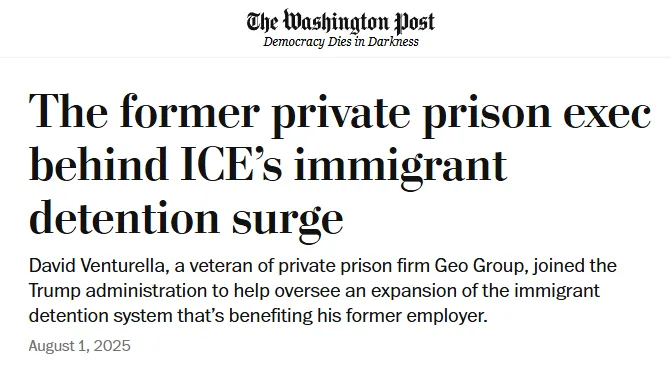
The waiver has functioned. GEO’s principal access to ICE money runs through a complex Navy procurement system used to disburse most of the $45 billion the Navy distributed last year, allowing ICE to direct contracts to GEO without competitive bids. GEO’s competitors — other private detention operators eyeing the same expanding market — have not received comparable channels of access.
By industry estimate, GEO Group is positioned to receive tens of billions of federal dollars over the next four years for detaining immigrants. The procurement officer who directs those contracts came directly from the company that receives them.
Read original →
Seventy-Three Percent
Feb 18, 2026 ·
The Bulwark
Of people booked into Immigration and Customs Enforcement custody since the start of the second Trump administration's enforcement push, seventy-three percent had no criminal conviction of any kind; eight percent had a conviction for a violent or property offense.
Of the people booked into Immigration and Customs Enforcement custody between October 1, 2025 and the date of the available data, seventy-three percent had no criminal conviction of any kind. Eight percent had a conviction for a violent or property offense. The remaining nineteen percent had been convicted of something — most commonly an immigration-related offense, including the act of unlawful presence itself.

The figure cannot be reconciled with the administration’s repeated framing of mass enforcement as targeted toward “the worst of the worst” or “criminal illegal aliens.” The framing requires that the people in custody be the people the framing describes; the data show, to a near-three-quarters majority, that they are not.
Read original →
Twenty-Three Hours
Mar 16, 2026 ·
NBC News
Mohommad Nazeer Paktyawal, an Afghan father of six who had worked alongside the US military in Afghanistan and was applying for asylum, died less than twenty-four hours after Immigration and Customs Enforcement detained him outside his apartment in suburban Dallas.
Mohommad Nazeer Paktyawal, age forty-one, was preparing to take his children to school on a Friday morning when a group of masked men drove up to his apartment complex in Richardson, Texas, and placed him in handcuffs. He had worked alongside the US military in Afghanistan, had no known health conditions, and was applying for US asylum. He died in Immigration and Customs Enforcement custody less than twenty-four hours after his arrest.
ICE described the deceased man, in its initial public statement, as a “criminal illegal alien from Afghanistan” and said the cause of death was under investigation. The phrase “criminal illegal alien” was not accompanied by reference to any specific charge, conviction, or proceeding.
Paktyawal left six children. He was not in custody long enough for any of the procedural mechanisms the United States nominally extends to asylum applicants to begin to function.
Read original →
Thirteen Thousand Sent Anywhere But Home
Mar 21, 2026 ·
BlueSky, Aaron Reichlin-Melnick
Thirteen thousand people have been removed under the third-country deportation framework — many under removal orders issued decades earlier that prior administrations would not have enforced this way.
Through early 2026, thirteen thousand people had been removed from the United States under the third-country deportation framework — many of them subject to removal orders issued decades or generations earlier and never previously enforced this way. The destinations were not the deportees’ countries of origin but whatever third countries could be persuaded or coerced to receive them.
The legal authority for such removals is contested but technically existent. What is genuinely new is the willingness to use it at scale, combined with the choice of destination. Previous administrations encountered the same dormant orders and the same statutory tools and concluded — generally without articulating the reasoning — that the cost in destabilized lives, in deaths in unfamiliar countries, and in international relationships was not worth the enforcement gain. That cost-benefit calculation has been reversed.
Read original →
The Memo That Said What ICE Already Did
Mar 25, 2026 ·
The American Prospect
The legal memo ICE used for more than a year to justify courthouse arrests does not, on its face, grant that authority — a fact ICE's own counsel has now confirmed in writing to the Southern District of New York.
Since May 2025, Immigration and Customs Enforcement officers have been arresting undocumented people as they showed up for routine immigration court hearings at federal buildings such as 26 Federal Plaza in New York. The agency justified the practice by invoking an internal memo dated May 27, 2025, titled “Civil Immigration Enforcement Actions in or Near Courthouses” — the so-called 2025 ICE Guidance.
A March 2026 letter from Jay Clayton, US Attorney for the Southern District of New York, recorded ICE legal counsel’s admission that the memo “does not and has never applied” to immigration court hearings. The arrests had been ongoing for more than a year by the time that admission was put in writing.
The legal authority pointed to had been a misreading of the agency’s own document. The displaced consequence — the people arrested, processed, removed, or released after the missed hearings — is not retroactive.
Read original →
Hanne Engan, Type 1 Diabetic, Detained
Mar 29, 2026 ·
Daylight San Diego, Kate Morrissey
Hanne Engan, a Norwegian woman married to an American citizen, was detained at her green card appointment in San Diego; while in custody at Otay Mesa, the equipment and insulin she needs to manage her Type 1 diabetes were withheld, she was nearly killed multiple times, and after her release she discovered her credit-card information had been stolen while she was in detention.
Hanne Engan is a Norwegian citizen married to an American. When she arrived for her green card interview in downtown San Diego, Immigration and Customs Enforcement officers detained her at the appointment. They separated her from the continuous-glucose monitor she wears for Type 1 diabetes and from her insulin, and transported her to the Otay Mesa Detention Center.

Engan’s diabetes escalated rapidly under the conditions of confinement. Without her monitor or her insulin she was, by her own account, near death on multiple occasions during her detention; staff response to her medical condition was both delayed and inadequate. After her eventual release she discovered, separately, that her credit-card information had been used while she was in custody.
Read original →
Tracking the Scale of ICE Detention's First Year
Apr 22, 2026 ·
BlueSky, Adam Sawyer
Federal data through March shows more than 450,000 people experienced ICE detention in the Trump administration's first fourteen months — a count that includes both new bookings and inter-facility transfers.
More than 450,000 people moved through Immigration and Customs Enforcement custody in the first fourteen months of the second Trump administration, according to federal detention data through March 2026. The count combines initial bookings and transfers between facilities, exceeding the standing federal detention capacity several times over — a measure of throughput rather than headcount.
Each entry represents a person held, processed, and either released, removed, or transferred onward; the administrative paperwork that distinguishes “detention” from “transfer” is not visible from inside the cell. The data is federal record, not estimate, reconstructed by independent researchers from statistics that immigration enforcement agencies have not chosen to publish in aggregate themselves.
Read original →