After U.S. District Judge Sara Ellis issued a temporary restraining order on October 9 limiting federal agents' use of crowd-control weapons against Illinois protesters, court filings allege that federal agents violated the order 'almost every day,' including a Halloween-eve incident in which children on their way to a school parade were tear-gassed.
On October 9, U.S. District Judge Sara Ellis issued a temporary restraining order against federal agents operating under Operation Midway Blitz in Illinois, restricting their use of tear gas, pepper spray, and other “riot control weapons” against protesters and journalists, and barring them from clearing people from public spaces those people had a lawful right to occupy. A subsequent court filing alleges that the order has been violated “almost every day” since it was issued. On October 25, federal agents reportedly deployed tear gas in Chicago’s Old Irving Park as children walked to a Halloween parade at their school. From the bench, on Tuesday, Judge Ellis said: “I can only imagine how terrified they were.”
When the judge asked Customs and Border Protection commander Gregory Bovino to produce all use-of-force reports from agents involved in Operation Midway Blitz since September 2, Bovino said it would be impossible because of “the sheer amount.” The court ordered the reports and accompanying body-camera footage produced by the end of the week. The volume of force itself — too large to assemble — is a piece of evidence that did not exist, in that quantifiable form, before the question was put.
A New York Times reconstruction of the September 12 Chicago-area shooting of Silverio Villegas-Gonzalez — drawing on surveillance footage, body-camera video, and bystander recordings — contradicts the DHS account: the videos do not show Villegas-Gonzalez striking either officer with his car, and one of the officers describes his own injuries on camera as 'nothing major.'
On September 12, two Immigration and Customs Enforcement officers stopped Silverio Villegas-Gonzalez, a thirty-eight-year-old Mexican immigrant, on a busy street in Franklin Park, Illinois, less than a minute after he had dropped off his two sons at an elementary school and a day care. Less than a minute after the stop, Villegas-Gonzalez was shot in the neck and his Subaru had crashed into a truck more than a hundred feet down the road. The Department of Homeland Security said he had hit and dragged one of the officers with his car, “seriously injuring” him; the officer had fired in self-defense. Villegas-Gonzalez was unarmed and had no criminal record beyond traffic offenses.
A New York Times reconstruction, drawing on multiple surveillance feeds, the officers’ body cameras, and bystander video, calls two specific elements of that account into question: the recordings do not show Villegas-Gonzalez striking either officer with the vehicle, and on his own body camera in the immediate aftermath one of the officers describes his injuries as “nothing major.” The reconstruction does not resolve every question about the encounter; it does demonstrate, frame by frame, that the official narrative — a self-defense killing of a man who had seriously injured a federal officer — is not supported by the recordings the federal officers themselves made.
Federal immigration agents in California arrested a U.S. citizen and drove away with the man's car — with his toddler still in the backseat — over the protests of a crowd that had gathered, and only after the crowd's intervention did agents permit the family to take the child.
Armed federal immigration agents in California stopped a vehicle, arrested its driver — a U.S. citizen — and prepared to drive off with the man’s car, in keeping with a routine in which a vehicle is left disabled in the road or impounded after a stop. Inside that vehicle, in a child seat, was the man’s toddler. A crowd of bystanders that had assembled at the scene refused to allow the agents to leave with the child still in the car. After the crowd’s intervention, the agents agreed to wait for the family to arrive and collect the toddler.
That the toddler was eventually retrieved is an outcome that depended on the crowd. The default trajectory — the procedural plan the agents began to execute before they were stopped — would have separated the child from any adult relative for at least the duration of the agents’ transport of the vehicle. The question of what protocol governs the disposition of children present at federal arrests is one the article suggests has no public answer; the operational answer, on this day, was the bystanders.
Randall Alberto Gamboa Esquivel, a fifty-two-year-old Costa Rican man held in ICE custody in Texas since February, was put on an air ambulance to Costa Rica in September while in a vegetative state with encephalopathy and rhabdomyolysis; he died in a hospital in his hometown in October.
Randall Alberto Gamboa Esquivel, fifty-two, was arrested by Immigration and Customs Enforcement in Texas in February and held first at the Webb County Detention Center, then in Port Isabel. His family spoke with him by phone daily until June, when the calls abruptly stopped. The detention center told them only that he had a “health issue.” Locating him took two months and three lawyers. By August, he was bedridden in a vegetative state. On September 3, ICE put him on an air ambulance to Costa Rica with diagnoses of encephalopathy, rhabdomyolysis, and the loss of his ability to feed himself. He died in a hospital in his hometown of Pérez Zeledón on October 26.
Asked about the case, DHS assistant secretary Tricia McLaughlin said the medical care Gamboa had received was better than many immigrants “have received in their entire lives,” and noted his prior immigration violations — answers that addressed neither what had happened to him nor why his family had been unable to find him for two months. The deportation of a man already in a vegetative state, by air ambulance, is the operational fact at the center of the case; the question of what happened to his body during the months his family could not reach him remains, formally, unanswered.
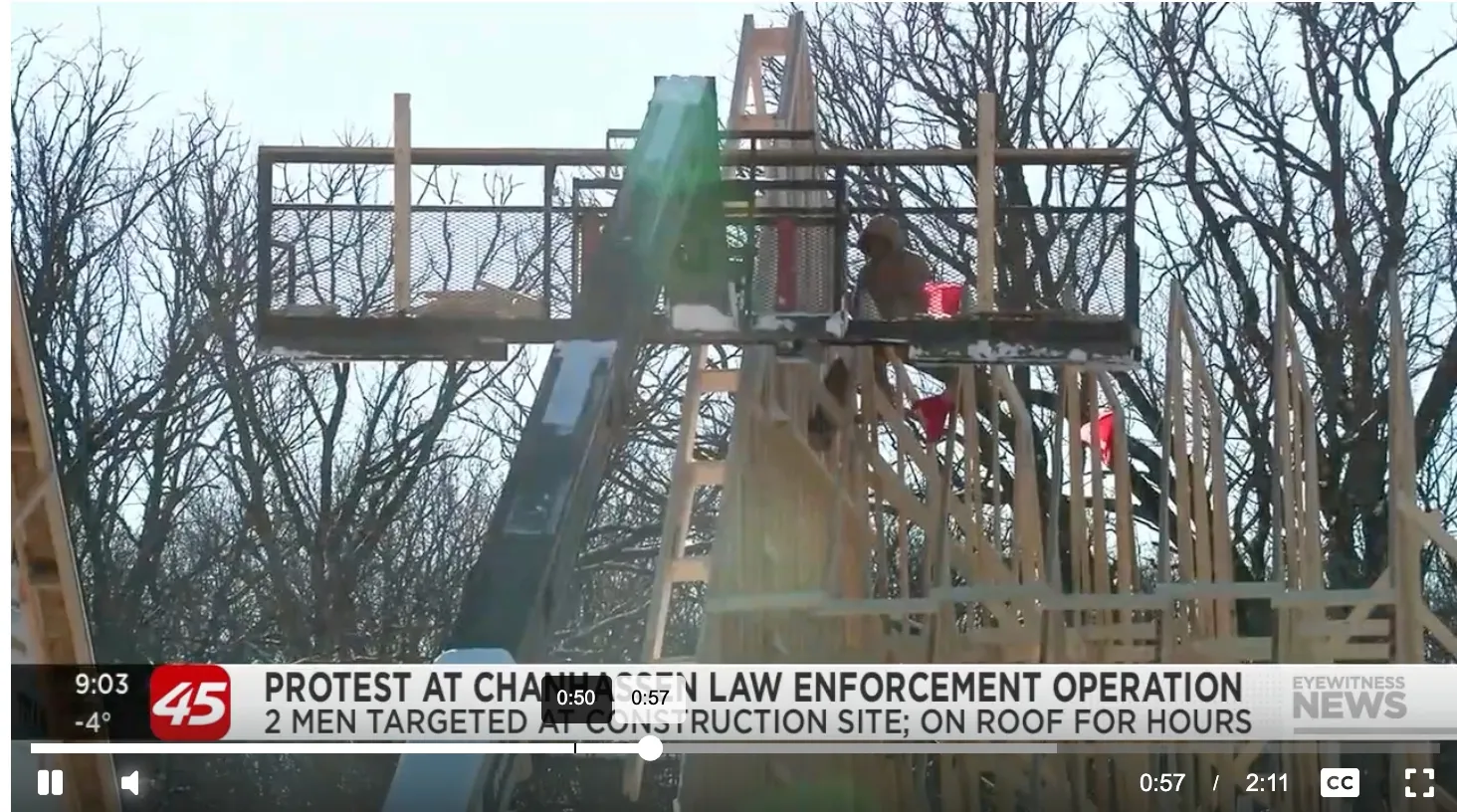
Masked federal agents wearing ICE vests, refusing to identify themselves or present warrants, cordoned off a Minneapolis construction site and trapped two men on the roof for hours in subzero temperatures; one was eventually taken away by ambulance.
Masked federal agents wearing ICE vests cordoned off a Minneapolis residential construction site, refused to identify themselves or present a warrant, and trapped two construction workers on the roof for hours in subzero temperatures. A protest crowd gathered. Bystanders carried heating pads, a jacket, and food; the agents prevented them from reaching the men on the roof.
A reporter at the scene counted at least thirty federal agents who took rotating shifts retreating to vehicles to stay warm — a temperature accommodation extended to the masked agents but not to the men they had cornered above. The agents eventually left; an ambulance removed one of the men from the roof.
The episode is at least the third documented case of federal immigration agents besieging construction workers on private residential job sites; comparable incidents had occurred in Chicago in October and outside New Orleans earlier in the year.
Federal agents deployed tear gas on a Minneapolis crowd that included children; the canisters shattered the window of a low-income apartment occupied by a disabled veteran, who was tear-gassed inside his own home.
Federal immigration agents deployed multiple canisters of tear gas on a Minneapolis crowd that included children participating in a march. The canisters shattered the window of a nearby low-income apartment occupied by a disabled veteran, who was tear-gassed inside his own home.
Witness accounts from the scene describe at least six tear-gas canisters and four to six flashbang explosions used against an unarmed crowd, and a rotating shift of federal agents retreating to vehicles to warm up between deployments. Bystanders carried water bottles, saline, and eye wash; the crowd was, by the witness’s specific phrasing, “prepared to help one another.”
A running tally maintained by independent observers records the United States military's thirty-eighth instance of unlawfully killing civilians under the orders of the Secretary of Defense and the President; the cumulative count of dead is at least one hundred thirty.
A running tally compiled from public reporting on US military operations in the Caribbean and elsewhere has recorded its thirty-eighth instance of the United States military unlawfully killing civilians under the orders of the Secretary of Defense and the President. The cumulative count of the dead is at least one hundred thirty. None of those killed were charged with a crime; the identities of most were not known to those who killed them.
The connecting thread visible from outside is the absence of an articulable legal framework. Strikes are described, in announcements when they are announced at all, as targeting “narcoterrorists” or other categorical enemies whose definitions are not given before the fact and whose qualification cannot be examined after. The constraint has shifted from law to assertion.
An Associated Press investigation, drawn from 911 calls and detainee accounts, reports that staff at the nation's largest ICE detention facility — Camp East Montana on Fort Bliss in Texas — placed bets on which detainee would next die by suicide; Camp East Montana sits on the site of a World War II Japanese American internment camp.
According to Associated Press reporting based on 911 call logs and detainee accounts, staff at Camp East Montana — the nation’s largest Immigration and Customs Enforcement detention facility, holding around three thousand people in tents on Fort Bliss in El Paso, Texas — operated a betting pool on which detainee would next die by suicide. Owen Ramsingh, a legal permanent resident held there for several weeks, told the AP that he overheard a guard say he had paid five hundred dollars into the pot, with payouts going to the staff member with the most accurate predictions. DHS told the AP that Ramsingh, who was brought to the United States from the Netherlands at age five, was lying. In January, the facility called 911 for Geraldo Lunas Campos, a fifty-five-year-old Cuban man; DHS reported it as an attempted suicide, but a medical examiner ruled the death a homicide. That same month, a thirty-six-year-old Nicaraguan man at the facility died by suicide.
The site itself is significant: Camp East Montana stands where Fort Bliss housed Japanese Americans during World War II. The AP’s review documents one hundred and thirty 911 calls in the first roughly five months of operation, including at least six additional self-harm incidents serious enough to require emergency response. The betting pool, if it operated as Ramsingh described, was therefore betting on a frequent enough event that wagering on its next instance was a structurally coherent activity for guards to organize.
Sworn declarations from detained children and parents at the Dilley Immigration Processing Center — the nation's only family detention facility, run by CoreCivic and reopened in 2025 — describe vomit-inducing food, denied medical care, intimidating guards, and a four-year-old who developed a black eye after hitting his head, his potential concussion left untreated.
The Dilley Immigration Processing Center in south Texas — closed by the Biden administration in 2024, reopened in 2025 as part of a forty-five-billion-dollar detention expansion — is the only ICE family detention facility in the country. It is run for ICE by the private prison corporation CoreCivic. Journalists are not permitted inside; congressional oversight visits, until earlier this month, required a week’s advance application. The body of evidence about life inside is therefore almost entirely indirect: sworn declarations submitted by detained children and parents to legal aid groups, some of them filed as exhibits in litigation, others collected by RAICES simply for the record.
Those declarations describe food that has caused a woman to vomit blood, denied or delayed medical and mental-health care, sleeping conditions that resist sleep, intimidation by guards, and a four-year-old who hit his head, developed a black eye, and was not assessed for concussion. DHS and CoreCivic have published websites refuting the claims. The methodological difficulty of testing those refutations — when journalists are barred and detainees’ communications are constrained — is itself part of the story. The closure of the channels through which evidence would normally be examined is what permits the official denials to operate as the only public record from inside the facility.
Oudone Lothirath, a Minnesota man with aggressive lymphoma, missed four of five scheduled chemotherapy sessions while in ICE detention in Texas in January; he was returned to Minnesota only after a hospital letter warned he would die without treatment, and he is now in hospice.
Oudone Lothirath, a Minnesota resident undergoing chemotherapy for aggressive lymphoma, was taken into Immigration and Customs Enforcement custody in January and held in a Texas facility. Of the five chemotherapy sessions scheduled during the period of his detention, he missed four. He received no medical care while in custody. After ten days, ICE released him — not in response to a lawsuit but to a letter from M Health Fairview stating that he would “succumb” without ongoing treatment. The Department of Homeland Security has dismissed reports of inadequate medical care as “false.”
Lothirath was hospitalized on arrival in the Twin Cities with a bladder infection and sepsis. A scan in March showed the lymphoma had spread into his bone marrow during the interruption. He entered hospice on March 20. The article notes that his case is unusually well-documented — his caregiver kept correspondence; the hospital wrote a letter on the record — but situates it within a broader pattern of GoFundMe pages, untreated injuries, denied medications, and missed surgeries that other detained immigrants have left behind in fragments.
First Day of the Iran War: An Untested Missile Hit a School
Mar 30, 2026 ·
BlueSky, Christiaan Triebert
On the war's first day, the United States deployed a ballistic missile that had never been used in combat; analysis of the strike sites shows it hit a sports hall, an elementary school, and residential buildings, killing at least twenty-one including children.
On the first day of the war with Iran, a US ballistic missile previously unused in combat struck a sports hall, an elementary school, and residential buildings, killing at least twenty-one people including children. None of the targets were military by any conventional definition.
Forensic reconstruction — debris analysis, satellite imagery, civilian witness accounts — placed the strikes in the war’s first hours, when targeting decisions are still being calibrated against doctrine and intelligence is at its least mature. The choice to use an untested weapon in this window compounds the question of whether the targeting was deliberate, mistaken, or indifferent.
Whatever the answer, the dead are dead. The Pentagon has not, as of this writing, published a strike assessment that addresses the civilian harm.
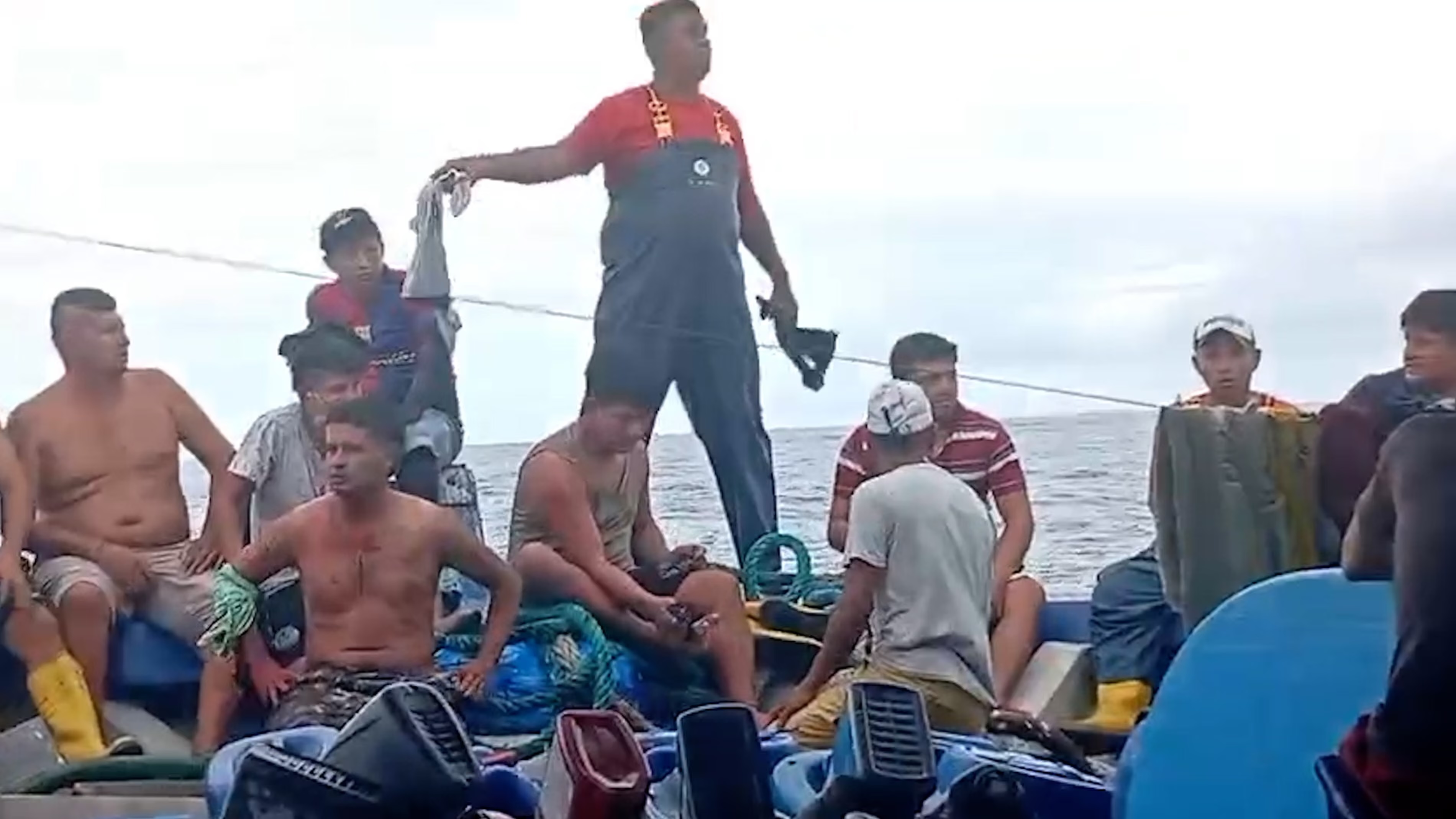
The crew of the Ecuadorian fishing vessel Don Maca. Photograph obtained by the Guardian.
Ecuadorian fishers aboard the Don Maca survived a US drone strike on their vessel during routine fishing operations; no evidence has been produced linking them or their boat to drug trafficking.
The crew of the Ecuadorian fishing vessel Don Maca were finishing a day of swordfish and albacore lines when a drone strike tore through the boat, shattering glass and injuring several. The crew were subsequently detained by US forces and questioned. The United States has produced no evidence connecting the crew or the vessel to drug trafficking.
The strike is part of what the second Trump administration has framed as a “war on narcoterrorists” — a phrase that operates as a label rather than a definition, and one the administration has not been required to substantiate before each operation. Legal experts and human rights organizations have characterized the resulting attacks, which have killed Ecuadorian, Venezuelan, and Colombian civilians at sea, as extrajudicial killings.
The Don Maca was not the first such vessel attacked, nor has the United States said how many crews remain unaccounted for from prior strikes. The survivors’ testimony exists because this strike did not finish them.