Theme: bureaucratic cruelty — full compilation
Harm inflicted at scale through systems, paperwork, and institutional indifference.
View as list →
Deported in a Vegetative State
Nov 6, 2025 ·
The Guardian
Randall Alberto Gamboa Esquivel, a fifty-two-year-old Costa Rican man held in ICE custody in Texas since February, was put on an air ambulance to Costa Rica in September while in a vegetative state with encephalopathy and rhabdomyolysis; he died in a hospital in his hometown in October.
Randall Alberto Gamboa Esquivel, fifty-two, was arrested by Immigration and Customs Enforcement in Texas in February and held first at the Webb County Detention Center, then in Port Isabel. His family spoke with him by phone daily until June, when the calls abruptly stopped. The detention center told them only that he had a “health issue.” Locating him took two months and three lawyers. By August, he was bedridden in a vegetative state. On September 3, ICE put him on an air ambulance to Costa Rica with diagnoses of encephalopathy, rhabdomyolysis, and the loss of his ability to feed himself. He died in a hospital in his hometown of Pérez Zeledón on October 26.
Asked about the case, DHS assistant secretary Tricia McLaughlin said the medical care Gamboa had received was better than many immigrants “have received in their entire lives,” and noted his prior immigration violations — answers that addressed neither what had happened to him nor why his family had been unable to find him for two months. The deportation of a man already in a vegetative state, by air ambulance, is the operational fact at the center of the case; the question of what happened to his body during the months his family could not reach him remains, formally, unanswered.
Read original →
Seventy Years, A Refugee Camp, Alligator Alcatraz
Nov 17, 2025 ·
Orlando Sentinel, Olivia Messer
Paul Bojerski, seventy-nine, was born to Polish parents in a German refugee camp after World War II and emigrated legally to the United States with his family in 1952; in July of 2025 he was detained at a routine ICE check-in and sent to the Everglades detention camp known as Alligator Alcatraz on a decades-old removal order that had previously gone unenforced.
Paul John Bojerski was born in 1946 to Polish parents in a German camp for displaced persons left over from the war. The family emigrated legally to the United States in 1952, when he was five. He grew up in Cleveland, never became a citizen for reasons no surviving paperwork makes clear, accumulated a deportation order at some point that authorities had elected for decades not to enforce, and lived a working life in Florida — retired optician, husband, stepfather. He had checked in regularly with Immigration and Customs Enforcement for years. In July 2025, at one of those routine check-ins at age seventy-nine, he was told that if he did not leave the country voluntarily, ICE would deport him.
He could not leave. He had no passport, no country of citizenship to receive him, no other state that recognized him. He returned to ICE on October 30 as instructed; he was taken into custody and sent to Alligator Alcatraz, the federal detention site improvised in the Everglades, then transferred to the Krome Detention Center near Miami. His attorney, with thirty years in immigration practice, told the Orlando Sentinel that Bojerski’s case was the most bizarre one he had handled. The decades-old removal order had not changed. What had changed is that someone, somewhere, decided that this was now the kind of order that would be acted on.
Read original →
She Has Not Gone Outside
Feb 3, 2026 ·
KARE 11
Thi Dua Vang, a Hmong asylum-seeker in St. Paul who fled religious persecution in Vietnam and has legal status in the U.S., was detained by ICE in January, transferred to Texas, and ordered released by a judge after two weeks; since her return, she has been unable to leave her home because ICE agents continue to come to the door.
Thi Dua Vang fled Vietnam, where her family had been persecuted for being Christian, with a brother who had been imprisoned for his faith. She lived undocumented in Thailand for more than seven years before the family was granted asylum in the United States in December 2023. She had applied for a green card and was awaiting final approval. On the morning of January 8, six ICE agents came to her family’s St. Paul home; her son opened the door. Vang speaks Hmong; her brother, who interpreted for her, says the agents would not state a reason. She was transferred the next day to El Paso, then to Houston. At one point she was brought onto a runway in a plane she believed was deporting her to Vietnam before being pulled off. After two weeks, an immigration judge ordered her released on bond.
Five days after her release, in compliance with the conditions of her bond, Vang completed a check-in with ICE; she was free to go. Since then, she has not been able to leave her home. She has lost her job. According to her account in the article, ICE agents have continued to come to the house. The release order, the bond, and the legal-status documents — the formal pieces of paper an immigration system is supposed to use to certify that a person is not to be detained again — have not, in her case, foreclosed the possibility of being detained again.
Read original →
After the Letters Were Published
Feb 17, 2026 ·
BlueSky, Nathan Kalman-Lamb
Letters from children imprisoned in the Dilley, Texas family detention camp — including a seven-year-old held for seventy days, a five-year-old, and a nine-year-old held for one hundred thirteen days — reached ProPublica. The day the resulting story was published, federal personnel raided the dormitories to confiscate further letters.
A seven-year-old child from Venezuela, Mia Valentina Paz Faria, was held in the Dilley, Texas family detention camp for seventy days. In a letter to the outside, she wrote: “I don’t want to be in this place I want to go to my school.” Hers was one of several letters that reached ProPublica reporters and was published in the resulting story.
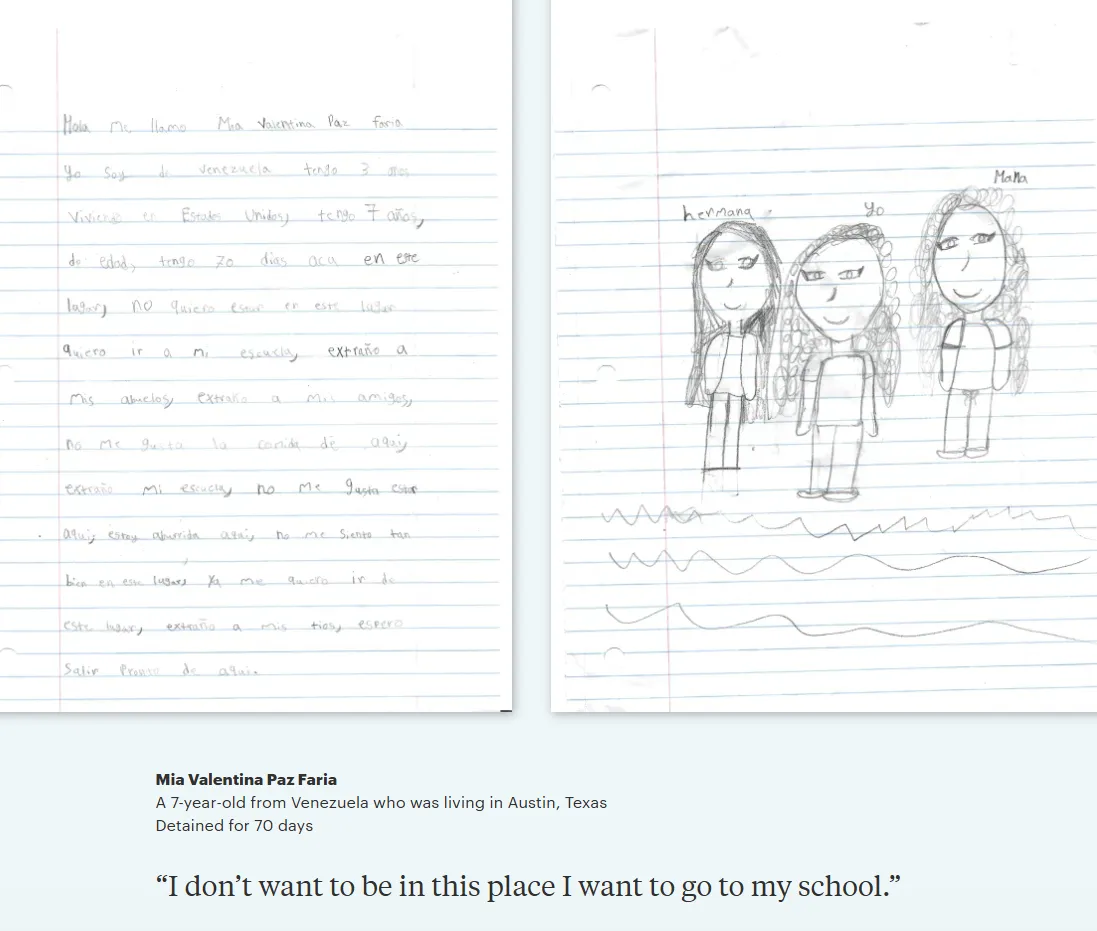
The published letters carried the voices of multiple children at the same facility. A nine-year-old held one hundred thirteen days wrote, “Me in dilei [Dilley] am not happy please get me out of here to colombia.” A five-year-old wrote two words: “My family.” Mothers at the camp described children who had begun cutting themselves and talking about suicide, and who were finding worms and mold in their food.
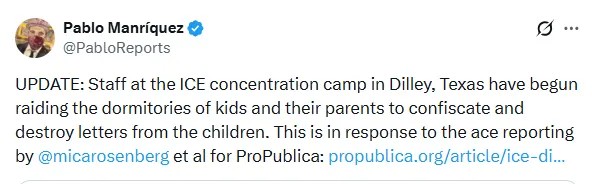
The day the ProPublica story was published, federal personnel raided the camp’s dormitories to confiscate and destroy further letters from the children. The administrative response to the publication was not an investigation of the conditions described, nor an accommodation of the children’s stated wishes, but the elimination of the specific medium that had let those statements escape.
Read original →
Not Accidental
Feb 19, 2026 ·
BlueSky, Gravel Influencer
Deaths in immigration detention now match the patterns recorded in the early phases of past regimes' concentration camps: poor conditions, untreated disease, abuse — not random misfortune but the predictable output of a custodial system designed for harm.
Deaths in US immigration detention now match the patterns recorded in the early phases of past regimes’ concentration-camp systems: deaths from poor conditions, untreated disease, untreated injury, and abuse. The pattern is not random misfortune. It is the predictable output of a custodial system whose design parameters — overcrowding, medical neglect, indefinite holds, restricted oversight — produce deaths as a statistically expected result.
The historical analogy is not rhetorical. It is a description of what happens when the same operational choices are made.
Read original →
The Pool
Mar 7, 2026 ·
Mother Jones
An Associated Press investigation, drawn from 911 calls and detainee accounts, reports that staff at the nation's largest ICE detention facility — Camp East Montana on Fort Bliss in Texas — placed bets on which detainee would next die by suicide; Camp East Montana sits on the site of a World War II Japanese American internment camp.
According to Associated Press reporting based on 911 call logs and detainee accounts, staff at Camp East Montana — the nation’s largest Immigration and Customs Enforcement detention facility, holding around three thousand people in tents on Fort Bliss in El Paso, Texas — operated a betting pool on which detainee would next die by suicide. Owen Ramsingh, a legal permanent resident held there for several weeks, told the AP that he overheard a guard say he had paid five hundred dollars into the pot, with payouts going to the staff member with the most accurate predictions. DHS told the AP that Ramsingh, who was brought to the United States from the Netherlands at age five, was lying. In January, the facility called 911 for Geraldo Lunas Campos, a fifty-five-year-old Cuban man; DHS reported it as an attempted suicide, but a medical examiner ruled the death a homicide. That same month, a thirty-six-year-old Nicaraguan man at the facility died by suicide.
The site itself is significant: Camp East Montana stands where Fort Bliss housed Japanese Americans during World War II. The AP’s review documents one hundred and thirty 911 calls in the first roughly five months of operation, including at least six additional self-harm incidents serious enough to require emergency response. The betting pool, if it operated as Ramsingh described, was therefore betting on a frequent enough event that wagering on its next instance was a structurally coherent activity for guards to organize.
Read original →
Twenty-Three Hours
Mar 16, 2026 ·
NBC News
Mohommad Nazeer Paktyawal, an Afghan father of six who had worked alongside the US military in Afghanistan and was applying for asylum, died less than twenty-four hours after Immigration and Customs Enforcement detained him outside his apartment in suburban Dallas.
Mohommad Nazeer Paktyawal, age forty-one, was preparing to take his children to school on a Friday morning when a group of masked men drove up to his apartment complex in Richardson, Texas, and placed him in handcuffs. He had worked alongside the US military in Afghanistan, had no known health conditions, and was applying for US asylum. He died in Immigration and Customs Enforcement custody less than twenty-four hours after his arrest.
ICE described the deceased man, in its initial public statement, as a “criminal illegal alien from Afghanistan” and said the cause of death was under investigation. The phrase “criminal illegal alien” was not accompanied by reference to any specific charge, conviction, or proceeding.
Paktyawal left six children. He was not in custody long enough for any of the procedural mechanisms the United States nominally extends to asylum applicants to begin to function.
Read original →
Inside Dilley
Mar 26, 2026 ·
Mother Jones
Sworn declarations from detained children and parents at the Dilley Immigration Processing Center — the nation's only family detention facility, run by CoreCivic and reopened in 2025 — describe vomit-inducing food, denied medical care, intimidating guards, and a four-year-old who developed a black eye after hitting his head, his potential concussion left untreated.
The Dilley Immigration Processing Center in south Texas — closed by the Biden administration in 2024, reopened in 2025 as part of a forty-five-billion-dollar detention expansion — is the only ICE family detention facility in the country. It is run for ICE by the private prison corporation CoreCivic. Journalists are not permitted inside; congressional oversight visits, until earlier this month, required a week’s advance application. The body of evidence about life inside is therefore almost entirely indirect: sworn declarations submitted by detained children and parents to legal aid groups, some of them filed as exhibits in litigation, others collected by RAICES simply for the record.
Those declarations describe food that has caused a woman to vomit blood, denied or delayed medical and mental-health care, sleeping conditions that resist sleep, intimidation by guards, and a four-year-old who hit his head, developed a black eye, and was not assessed for concussion. DHS and CoreCivic have published websites refuting the claims. The methodological difficulty of testing those refutations — when journalists are barred and detainees’ communications are constrained — is itself part of the story. The closure of the channels through which evidence would normally be examined is what permits the official denials to operate as the only public record from inside the facility.
Read original →
Four Out of Five Chemotherapy Sessions
Mar 26, 2026 ·
Star Tribune, Bryce Covert
Oudone Lothirath, a Minnesota man with aggressive lymphoma, missed four of five scheduled chemotherapy sessions while in ICE detention in Texas in January; he was returned to Minnesota only after a hospital letter warned he would die without treatment, and he is now in hospice.
Oudone Lothirath, a Minnesota resident undergoing chemotherapy for aggressive lymphoma, was taken into Immigration and Customs Enforcement custody in January and held in a Texas facility. Of the five chemotherapy sessions scheduled during the period of his detention, he missed four. He received no medical care while in custody. After ten days, ICE released him — not in response to a lawsuit but to a letter from M Health Fairview stating that he would “succumb” without ongoing treatment. The Department of Homeland Security has dismissed reports of inadequate medical care as “false.”
Lothirath was hospitalized on arrival in the Twin Cities with a bladder infection and sepsis. A scan in March showed the lymphoma had spread into his bone marrow during the interruption. He entered hospice on March 20. The article notes that his case is unusually well-documented — his caregiver kept correspondence; the hospital wrote a letter on the record — but situates it within a broader pattern of GoFundMe pages, untreated injuries, denied medications, and missed surgeries that other detained immigrants have left behind in fragments.
Read original →
Hanne Engan, Type 1 Diabetic, Detained
Mar 29, 2026 ·
Daylight San Diego, Kate Morrissey
Hanne Engan, a Norwegian woman married to an American citizen, was detained at her green card appointment in San Diego; while in custody at Otay Mesa, the equipment and insulin she needs to manage her Type 1 diabetes were withheld, she was nearly killed multiple times, and after her release she discovered her credit-card information had been stolen while she was in detention.
Hanne Engan is a Norwegian citizen married to an American. When she arrived for her green card interview in downtown San Diego, Immigration and Customs Enforcement officers detained her at the appointment. They separated her from the continuous-glucose monitor she wears for Type 1 diabetes and from her insulin, and transported her to the Otay Mesa Detention Center.

Engan’s diabetes escalated rapidly under the conditions of confinement. Without her monitor or her insulin she was, by her own account, near death on multiple occasions during her detention; staff response to her medical condition was both delayed and inadequate. After her eventual release she discovered, separately, that her credit-card information had been used while she was in custody.
Read original →